height

Tuesday, April 26, 2011

Let Us Burn the Gondolas: Venice as a Modern City in 'Rethinking History'

My photoessay entitled 'Let Us Burn the Gondolas: Venice as a Modern City' has just been published in the Routledge journal Rethinking History, with which I have a long-standing relationship. It is part of an issue (vol, 15, no. 1, 2011) edited by James Goodman on 'History as creative writing', which includes contributions in various formats (including poetry) by historians and writers such as Martha Hodes and Gregory Downs. There is additional discussion and more photographs from the project on this blog. Buying articles from academic journals is always prohibitively expensive for individuals, but if you have any kind of university affiliation, try accessing it through your library, who may have an online subscription to Rethinking History.

San Toma, Venice, 2003

Wednesday, April 6, 2011

Appearance at 'Penguin Plays Rough' Night in Newtown this Saturday

This Saturday I shall be giving a short reading as part of the 'Penguin Plays Rough' night, which is a regular feature of Newtown's cultural life. Below is the notice by organiser Pip Smith from the PPR site:

Saturday April 9 8pm

Behold! The next PPR is at hand! I know it’s been longer than a month, but what with irritating book hiccups, I’ve been shackled to my laptop and unable to service your live fiction needs as regularly as I’d like to. But, after a hearty meal of spinach and liver, I have been able to burst free of my chains just in time to deliver you the most diverse sample of short stories this side of the 1970s. Check this out for diversity:

Miles Merrill: is the Artistic Director/ Creator/ CEO/ reigning monarch/king shit/ Godfather of The Australian Poetry Slam. He’s also a spoken-word artist in his own right and has opened for Saul Williams, wrote and co-directed a show in the Sydney Festival and performed solo at the Sydney Opera House. He’s the real deal, so be sure to see him in the flesh.

Jonathan Walker: is not only an expert on Venetian spies and diplomats (Cambridge University certified), but he is also the author of an “illuminated novel”, Five Wounds (see his website for details: www.jonathanwalkervenice.com). Jonathan will be reading from his novel, accompanied by projected illuminations.

Mark Sutton: Sydney University Story Club regular, one time liquor store employee, and current crossword compiler for ladies gossip magazines, Mark Sutton is very funny. I have witnessed his hilariousness, and it is indeed both wry and giggle-worthy.

Megan Garret-Jones: is a performance artist who has collaborated with Team Mess, and is one of the coordinators of Monthly Friend. She has performed her works at the Melbourne Fringe Festival and the Red Rattler. She once read a story about an octopus at Penguin Plays Rough. I remember, because there is a photo of her on our website with her hand perched on her head in the way an octopus might.

Ramon Glazov: not only has an excellent name, but is also the author of a very particular and Kafka-esque (yes, I just used that adjective) story that I STILL remember (even though I read it years ago) from the Cutwater Anthology. He’s going to read a story called “A Dispatch from the Golden Triangle” about a gambling town in Burma. Can’t get much more far-reaching than that, my peoples.

See you on Saturday. I am going to bake something edible you all can eat, too. God knows what yet, but it will be a tasty surprise.


The event will be held at the usual venue, which is at 4 Lackey Street, St Peters; time 8-10.30ish. I believe that there is a cover charge of $5 to enter, and that there will also be open mic readings in between the programmed entries listed above. Sounds like good value to me!

Tuesday, March 22, 2011

2010 Aurealis Awards Shortlist

Five Wounds is one of the shortlisted titles in the 'Best Illustrated Book / Graphic Novel' category in the 2010 Aurealis Awards for Australian Speculative Fiction. The other shortlisted candidates for this category include Nicki Greenberg and Justin Randall (fellow guests on 3CR's The Comic Spot). Good luck to all the other authors shortlisted for all the various categories, some of whom I met recently at the Worldcon in Melbourne or the Sydney Freecon.

Thursday, January 27, 2011

Five Wounds: Review at 'Literary Minded'

A very nice review by guest writer Lyndon Riggall at Literary Minded. An excerpt is below:

The story itself is a beautifully written and illustrated journey, but for me what made the novel truly ‘illuminated’ was the way in which the book refused to settle. Five Wounds is no summer beach distraction, it’s an intensely involved reading experience. .... For me the journey of reading the book was one of active problem-solving and code-breaking, and not only is this no bad thing; judging by the novel’s curious annotations, edits, and conflicting final chapters, I think it is also absolutely the intention of its authors.

Friday, January 14, 2011

Podcast of session on 'Modern Dystopia' at the Melbourne Writers Festival

Back in August, I appeared with DBC Pierre at the Melbourne Writers Festival in a discussion on 'Modern Dystopia'. This session was recorded by Radio National, and an edited version was broadcast on Monday 17 January as part of their 'Best of the fests' programming. The discussion moderator was Justin Clemens

UPDATE: You can now download a podcast of the programme. I have also uploaded the relevant section of the audio below. 

SECOND UPDATE: There is now further discussion of the ideas raised in our discussion here.


N.B. I am actually talking about Five Wounds in the session, even though the presenter mentions Pistols! Treason! Murder! in the introduction.
Thursday, December 9, 2010

Digital Editing, Digital Humanities: A Symposium at the University of Sydney

I shall be one of the participants in the symposium Digital Editing, Digital Humanities, which takes place in the Woolley Common Room, Woolley Building, University of Sydney, tomorrow (Friday 10 Dececmber 2010), from 9.30-5.00ish. The symposium has been organised by Mark Byron and William Christie. Further information is available on Mark Byron's blog. I'm on in the afternoon as part of a group presentation.

Plenary Speaker: Bethany Nowviskie, University of Virginia

This event brings together scholars, artists, and archivists working within the digital domain, both in Sydney and further afield. A primary focus of the symposium is to raise awareness of the variety of digital projects currently in progress in the Digital Humanities, and to discuss the kinds of digital resources available to scholars.

The symposium aims to showcase projects across the humanities, and to foster discussion of potential collaboration, funding, and the best use of available and potential resources. Three sessions will follow the plenary:

1. scholarly editing of medieval and modern literary texts;

2. projects in the visual arts, Buddhist Studies, history, the culture of robotics;

3. a roundtable concerning resources on campus, including SETIS, Heurist and Fisher e-Scholarship.

Monday, December 6, 2010

Typographic Design in Jean-Luc Godard's Films


The talk above is by Laura Forde. For more on the same topic, see this blog post by Andrea Hyde.

I have been watching the Godard films under discussion recently as part of the preparation / research for a new graphic project I am working on with Dan Hallett.


Thursday, December 2, 2010

'Little Dorrit' by Christine Edzard (1987)

[Originally posted on Literary Minded:]


In the Summer of 1989, I left my father’s home, which was never my home, not after my mother died. I couldn’t stand it there, in my father’s home, in the dark there, with the recessed windows and the ceilings, so low I used to bang my head on the doorjambs. The smell was what really used to get to me, as if it had seeped into the stone floors.

Child of an unfortunate father.

In the Summer of 1989, I left my father’s home, which was no longer my home. I left for Liverpool, knowing that I would only be there a few months, until I went north to university in October. I had no job and no money, but an older friend had just bought a gutted house that he was planning to renovate. I could stay there in one of the upstairs bedrooms.

A delicate appeal for a small temporary accommodation.

There was a streetlamp directly outside my window, which had no curtains. I turned the bare lightbulb off before I undressed, and I slept under the orange glow of sodium, on the floor, in a sleeping bag, on cushions I borrowed from the sofa downstairs. I took the cushions back downstairs every morning.

I shared the house with three other young men: two mechanics and a binman, who were in the habit of lying around watching television and eating takeaway food when they got home, in their workclothes, lying on the same sofa I used for my bedding. So the cushions were never especially clean.

Shabby.

Some things in the house worked. The toilet in the bathroom flushed, and there was an electric shower mounted over the bath that emitted a thin, feeble stream, which alternated between scalding hot and lukewarm as the circuit breaker kicked in and out. The cold tap in the kitchen also worked. But that was it for water. You had to boil it on the gas stove if you wanted it really hot, and most of the washing took place in the kitchen sink.

Faculties evidently decaying.

The boards on the kitchen floor had been ripped up in preparation for redoing the plumbing, exposing the gas pipes feeding the cooker, and the only heat source in the house was a fire in the living room, the same room with the sofa and the television. The electricity was supplied by a meter system, into which coins had to be fed regularly.

Tuppence please.

Nobody had figured out the local council’s garbage collection system, but there was a backyard, so whenever a garbage bag filled up, one of us tied it off and threw it out the back door. No-one dared to go out in the yard after dark.

The flies trouble you, don’t they me dear?

It was entertaining enough for a couple of months. I was glad to get away in October, but it was still the only available place to stay when I came back to Liverpool after my first term at university. I didn’t want to go to my father’s home. I couldn’t go back there. He wasn’t speaking to me. So I was back sleeping on the smelly sofa cushions. Still, it wasn’t so bad. It’s never bad with people who care about you.

I’m a friend. Remember?

A film version of Charles Dickens’ novel Little Dorrit was part of the Christmas television schedule that year. It was a six-hour adaptation, shown in two separate three-hour parts.

I decide to give it a go. Thirty minutes later, I’m hooked, but there’s hardly any credit left on the electricity meter, and there are no fifty-pence coins anywhere in the house.

Nobody’s to blame. Noise, fatigue, a moment’s inattention.

‘Turn everything off except the television’, I say. ‘All the lights, the fridge, don’t take a shower, don’t use the microwave, don’t wash your clothes, don’t dry your hair, don’t listen to music. If the power cuts before the film ends, I’m going to go crazy’.

Paid to squeeze. Squeeze to pay.

I haven’t read the novel, so I can’t even guess how it’s going to end – except that probably somebody is going to get married, and probably somebody else is going to die.

‘What are you watching?’
Little Dorrit’.
‘How long?’
‘Three hours’.
‘Three hours? Bloody hell’.
‘Six, actually. Two parts’.
‘Are you mad?’
‘Humour me. I want to know what happens’.

Pancks the gypsy. Fortune-telling.

Another thirty minutes later, I’m shivering in the twilight glow of the television when the doorbell rings.

‘Can you get that?’
‘Merry Christmas!’, someone outside says. ‘What’s up?’
‘Sssh! We’re watching Little Dorrit!’
‘What’s Little Dorrit?’
‘Come in. I’ll explain’.

We watch Little Dorrit, together.

The meter turns, infinitesimally slowly.

How can you speak of forever to a maimed creature like me?

The story advances, faster.

[All phrases in Arial are excerpts of dialogue taken from the film version of Little Dorrit, dir. Christine Edzard (1987).]

Monday, November 29, 2010

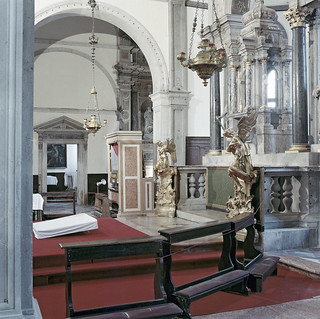
Santa Maria Formosa, Venice, 2002

Santa Maria Formosa, Venice, 2002

I had about forty-five minutes inside the church of Santa Maria Formosa before the light went. I shot eight frames (I think), of which this is the best – though that's not saying much. What was I looking at? I remember noting the following (in no particular order):

1) The light in the window on the right shining through the columns of the altar.

2) The red of the carpet, the green on the front of the altar and the mottled, pinkish organ booth. If a space is not articulated by contrasts in the distribution of colour, then there’s no point in using colour film.

3) The two prominent hanging lamps, which represented a problem that I was unable to solve to my complete satisfaction (so that their current positions within the frame were a compromise).

4) The golden angels, and in particular the fact that one of them is being ‘stabbed’ in the head by a partially-visible statue on the altar behind.

5) The position of the column at the left in the foreground relative to the pediment of the doorway in the background.

6) The four objects covered in white cloths on the left side of the frame. (What exactly is the tilted object on the floor? I don’t know and it bothers me.)

7) The difference in the source and intensity (and hence the colour) of the light through the doorway on the left. I was less aware of the patch of cold light at the bottom right and I didn’t notice the colour shift in the column on the left at all. The latter effects are stronger on the film than they appeared to the naked eye.

8) The red thread running around the benches, which is a more delicate but more absolute boundary of the space within than the benches themselves. And it is somehow important that the thread is red. (N.B. The thread may not be visible in the miniatruzed version above.)

9) The figure in the painting through the door on the left. It was important to show all of it. (The figure is also difficult to see in the version here.)

The list could be extended – but never to the point where it includes everything in the frame.

Thursday, November 25, 2010

'Tree of Codes' by Jonathan Safran Foer


Tree of Codes
is Jonathan Safran Foer's new book, which is a 'treated' edition of The Street of Crocodiles by Bruno Schulz, in the spirit of Tom Phillips' A Humument. It is published by Visual Editions. There's a good interview with Safran Foer in the NYT (extract below).

Q.Where did this strong affinity for graphic design come from?

A.Where would the lack of interest in design come from? Why wouldn’t — how couldn’t — an author care about how his or her books look? I’ve never met an artist who wasn’t interested in the visual arts, yet we’ve drawn a deep line in the sand around what we consider the novel to be, and what we’re supposed to care about. So we’re in the strange position of having much to say about what hangs on gallery walls and little about what hangs on the pages of our books. Literature doesn’t need a visual component — my favorite books are all black words on white pages — but it would be well served to lower the drawbridge
.

Monday, November 22, 2010

Podcast on the Design of Five Wounds

The podcast of my talk on the design of Five Wounds, originally delivered to the Centre for the Book at Monash University on 20 Oct., is now available to download if anyone wants to listen to it at home. Alternatively, I have also uploaded and embedded the audio below.


The original talk was of course accompanied by illustrations. I have posted the most important of these below. The numerical headings are time cues, which refer to the point in the audio file at which I discuss the image in question. Anyone who wants to get a sense of what the book looks like before listening to the talk can check out these short videos, in which I flip through a copy and explain the various elements.

4:55: Freud Caricature

Freud Caraicature: What's On a Man's Mind


6:40 : Synaesthetic Paradise Diptych [I can't get this double image to work in the audio, and I waste a couple of minutes fiddling about with it]:

Synaesthetic Paradise (left panel)

Synaesthetic Paradise (right panel)


10:55: Plate 6: Cuckoo's reflection.

Plate 6: Cuckoo's reflection


12:00: Alternative Representation of Cuckoo's Face

Annotation


13:50: Gabriella's Shield

Gabriella's Coat-of-Arms


13:57: Magpie's Shield

Magpie's Coat-of-Arms


15:00: Heraldry Sketches

Heraldry Sketches for Five Wounds 1


15:15: Heraldry Grid

Grid of Index Shields for Five Wounds (draft)


15:40: Sample Page Layout [see also 18:30 for discussion of the illustration included within this sample page]

Five Wounds Sample Layout (right)


17:00: Running Head [N.B. The pages above and below are two sides of the same layout, and thus the running head below serves as a title card for the illustration on the page above.]

Five Wounds Sample Layout (left)


24:55: Geneva Bible Page Layout (1560)

1560 Geneva Bible


25:00: King James Bible Page Layout (1611)

1611 King James Bible


25:30: Modern Bible Page Layout

Modern Red Letter Bible


40:00: Plate 15: Cut me

Plate 15: Cut me

[All illustrations except the Freud caricature, the heraldry sketches and the page layouts are by Dan Hallett.]

Wednesday, November 17, 2010

Sydney Freecon, 19-21 November 2010

This weekend I shall be participating in the Sydney Freecon, organised by Garry Dalrymple of the Sydney Futurians. There will be several events featuring local science-fiction / fantasy / horror writers, all taking place in Bankstown public library or nearby. As the name implies, there is no charge for attendance.

I shall be there on Friday evening (when I shall be giving a short reading) and Saturday afternoon (when I might possibly be available for a 'kaffeeklatsch' open discussion with other attendees, depending on interest).

The current draft programme is here.

Monday, November 8, 2010

Transcendent Blankness

[Originally posted on the Melbourne Writer's Festival blog:]


The film Morvern Callar by Lynne Ramsay is based on a book by Alan Warner (although the source novel has a completely different tone to the adaptation). The title character is a young woman whose boyfriend has committed suicide as the film opens, leaving behind the manuscript of a novel, which Morvern then submits to publishers under her own name, successfully, as it eventually turns out.

The clip above is the final scene. It may not be apparent that Morvern is actually wearing earphones connected to a Walkman (this is pre-iPod), which provides an implied diegetic source for the soundtrack, even if the version we hear is obviously overdubbed. This theory is subsequently confirmed by the final few seconds of the clip, in which the sound is ‘overheard’ through earphones turned up too loud, although by that point there is no accompanying image, so that the sound only becomes literally diegetic after it has ceased to make sense in diegetic terms.

Clearly there is something else at stake besides narrative logic by the time we get to the black screen.

I remember going to a concert with friends when I was a teenager, when one of our group also insisted on wearing a Walkman, through which he listened to heavy metal, to register his disgust at the sappy Christian folk being performed on stage. This has always struck me as a peculiarly eloquent and perverse gesture, which expresses both the need to belong to a group and the inability to reconcile oneself to that need. I think that this same gesture, whose perversity goes unremarked in the clip, except insofar as its eloquence is amplified by the sound design, means something more in Morvern Callar, as the title of this post implies.

The sequence also works visually of course. It is not merely moving bodies filmed under a strobe. Rather, it is a tour-de-force of choreography and editing, in which a series of jump cuts disguise abrupt focal shifts as well as changes in the lighting.

'Transcendent blankness' is actually a pretty good description of the effect obtained in the films of Robert Bresson, who is one of Lynne Ramsay's influences (and on whom, more anon).

DEDICATED TO THE ONE I LOVE.

Friday, November 5, 2010

Five Wounds: Review at 'Transnational Literature'

The latest issue of the academic e-journal Transnational Literature includes a review of Five Wounds, written by Aliese Millington. An extract is below: Think back to your first trip with Alice tumbling down the rabbit hole, or how it felt to enter the Matrix after Neo takes the red pill. Five Wounds: An Illuminated Novel takes you down a similarly twisting path and leaves you pondering the journey well afterwards. Pooling influences trans-national, trans-cultural, trans-temporal and transart form, authors Jonathan Walker and Dan Hallett spin the story of ‘five wounded orphans [who] must face their traumatic origins’ (blurb). These tales are told through the fascinating combination of Walker’s proclamatory prose, Hallett’s Goya and comic-book influenced illustrations, a Bible-like layout and handwritten notations. Described as ‘cruel and arbitrary’ (blurb) by the authors, the world of Five Wounds looks and feels at once early renaissance, modern and apocalyptic. I am particularly pleased to see a review in a journal on transnational literature, since many of the sources for Five Wounds are Italian: notably, Italo Calvino and Tintoretto. Below is a selection of transnational sources taken from a detail of an illustration (by Dan Hallett) on p. 100 of the novel.

Transnational Literature

Monday, November 1, 2010

Mornings

[Originally posted on the Melbourne Writer's Festival blog:]

At this hour of the morning,’ he said, addressing nobody in particular, ‘people who are awake fall into two categories: the still and the already.

So says a character in Italo Calvino’s story ‘The adventure of a wife’ to the protagonist, who has wandered into a cafe at six a.m. She, like the speaker, falls into the first category, since she is on her way home after being out all night.

In 1994, I was up at six a.m. almost every morning, but for the first part of the year I was a ‘still’ and in the second part I was an ‘already’. In the 'still' part of the year, I worked on the night shift as a security guard at a cardboard factory. (I think that’s what they made. I didn’t really care, so I never bothered to find out). In the 'already' part of the year, I worked as a postman, and I started work at 5.45. In both jobs I set a record of sorts: I had the longest hair of any security guard in Glasgow that year; and later I was the slowest postman in the entire city.

I became a connoisseur of tiredness during this period. The first critical distinction to be made on that subject is related to Calvino’s observation, since the tiredness of staying up too late is qualitatively different from the tiredness of getting up too early.

Saturday, October 23, 2010

Guest Post on Literary Minded

The blog Literary Minded has now posted a short essay I wrote about watching Christine Edzard's film of Little Dorrit. An extract is below.

In the Summer of 1989, I left my father’s home, which was never my home, not after my mother died. I couldn’t stand it there, in my father’s home, in the dark there, with the recessed windows and the ceilings, so low I used to bang my head on the doorjambs. The smell was what really used to get to me, as if it had seeped into the stone floors.

Child of an unfortunate father.

In the Summer of 1989, I left my father’s home, which was no longer my home. I left for Liverpool, knowing that I would only be there a few months, until I went north to university in October. I had no job and no money, but an older friend had just bought a gutted house that he was planning to renovate. I could stay there in one of the upstairs bedrooms.

A delicate appeal for a small temporary accommodation.

Tuesday, October 12, 2010

Seminar at Monash University on 20 Oct.

Cover image for Five Wounds

Next week I shall be giving a talk sponsored by the Centre for the Book at Monash University on the design of Five Wounds. The talk will discuss in more detail some of the issues introduced in these videos, and will also explain the ways in which Five Wounds draws upon the history of the printed Bible.

Details are below:

Wednesday 20 October 2010
5.45 – 7.15 pm

McArthur Gallery, State Library of Victoria, Swanston Street, Melbourne CBD

(Directions to the McArthur Gallery at the SLV: walk through main ground-floor reading room, take the stairs adjacent to central lifts to Cowen Painting Gallery [level 2A], walk straight across into the Redmond Barry Reading room, then look right for the double glass doors "Maps, Rare Books etc." If any problems, ask staff on the main reference desk)


Attendance is free and everyone is welcome.

Saturday, October 9, 2010

Tristram Shandy by Visual Editions

VE1 Tristram Shandy from Visual Editions on Vimeo.

Visual Editions manifesto:

We think that books should be as visually interesting as the stories they tell; with the visual feeding into and adding to the storytelling as much as the words on the page. We call it visual writing. And our strap line is “Great looking stories.”

Monday, September 13, 2010

Inspirations: Cattle and the Creeping Things by The Hold Steady


For the effortless way in which it integrates Biblical stories and idioms into a resolutely secular narrative. And for this genius theological analysis:

I GUESS I HEARD ABOUT THE ORIGINAL SIN
I HEARD THE DUDE BLAMED THE CHICK
I HEARD THE CHICK BLAMED THE SNAKE
I HEARD THEY WERE NAKED WHEN THEY GOT BUSTED
I HEARD THINGS AIN'T BEEN THE SAME ROUND HERE SINCE

Saturday, September 11, 2010

Inspirations: A Matter of Life and Death by Powell and Pressburger (1946)


I saw A Matter of Life and Death on television in the 80s, and finally on a cinema screen in repertory in the early 90s at the GFT in Glasgow. Its current interest for me lies partly in its allegorical mode of storytelling, and its emphasis on production design in the service of this mode, as suggested in Ian Christie's essay on the film in the BFI Film Classics series (pp. 16, 18-19):

[A Matter of Life and Death is a] striking example of the reinvention of the masque. This form of spectacle, combining elements of verse drama, dance, music, scenery and costume, was popular in aristocratic and court circles in the sixteenth and seventeenth centuries. Masques were usually allegorical, with a mythological scenario which could also be read in terms of contemporary politics. The court masque reached its height during the reign of James I, with the playwright Ben Jonson developing its dramatic structure by adding a comic prelude or 'anti-masque', and the architect Inigo Jones using the almost unlimited funds available to introduce for the first time all the machinery of modern theatre - artificial lighting, moveable sets and magical effects - to create 'pictures with Light and Motion'. ....

It is by means of ... mythic association, together with the invocation of motifs from the two Shakespearian 'magic' plays, A Midsummer Night's Dream and The Tempest, that A Matter of Life and Death creates its masque-like story. Its characters are indeed not realistic individuals, even by the standards of 40s cinema, but are emblematic and allegorical: the Poet, his Beloved, the Heavenly Messenger, the Magician. They move in equally symbolic spaces: the Other World; and on earth, the Seashore, the Wood, the Palace, and that modern temple of mysteries, the hospital. And the machinery of the spectacle - most notably the giant escalator and the celestial amphitheatre, but also such an ultra-filmic effect as the giant eyelid closing over the screen under anaesthesia - is as important as were Jones's stage 'machines' for Jacobean masques.

Throughout, A Matter of Life and Death shifts backwards and forwards between purely allegorical, or fantastic, scenes, and melodrama: that is, heightened realism, which is, in its deliberate exaggeration, equally contrived. For example, in the clip above, note the implausible isolation of Kim Hunter's character on a dark set lit principally by a lurid red offscreen source, and the presence of an exaggerated ticking clock on the soundtrack, not to mention the dialogue, which flirts with absurdity, notwithstanding the absolute conviction with which David Niven delivers his lines, and their undeniable emotional impact. But all this is still within the bounds of realism, unlike the film's distinctive representation of the afterlife. The clip below follows on immediately after the one above.


Similarly, Five Wounds combines highly abstract elements with Grand Guignol violence.

PROP OR WINGS?

Thursday, September 9, 2010

Five Wounds: Review at Smá¹›ti-Åšruti

A very positive review at the blog Smá¹›ti-Åšruti (is that Icelandic?), whose author has done lots of research on Dan, Zoe and I. An extract below:

Images and little details within: the excellent cartouches throughout; the Solomonic columns with spectacular capitals and how almost inky black foreground column is; the Rota Fortunae of characters with Crow in his appropriate place; Cur's harrowed reflection on the blade; pipework winding through the text during the banquet; the curlicue of the candle holders and the efficient linework used to indicate the direction of light outside Cuckoo's bedroom door; the fencing diagrams; Cuckoo's seduction scene; Gabriella a replica of a classical Venus in Magpie's dream - excellent.

My favourite piece of art is the beautiful bit of marbling, a mushrooming red blotch against the milk white of the page particularly because it was such a simple but bold and perfect visual analogue for the text.


Annotation

Wednesday, August 25, 2010

My Worldcon Schedule

From 2-6 September, I shall be attending, and participating in, the annual Worldcon meeting of the World Science Fiction Society, which this year takes place in Melbourne. There are some big names in the field taking part: the guests of honour include Kim Stanley Robinson and my fellow Allen & Unwin author Shaun Tan.

The full programme is here. I am appearing on several panels, and will also be doing an individual reading and signing, and a 'kaffeeklatsch' (an informal meeting between an author and a small group of interested persons). My panels include the following:

Thursday 2 Sept., 1600, Room 204: Steal the Past, Build the Future: New Histories for Fantasy Fiction

Many fantasy novels and stories base themselves around a medieval European setting. Others tread a little further from such comfortable territory, presenting worlds inspired by 18th century Paris, or 11th century Viking sagas, or Ancient Rome and Egypt. What’s left? What are the creative opportunities and historical settings lying in wait from which authors might draw inspiration?

Amanda Pillar, Catherynne M. Valente, Jonathan Walker, Kate Elliott


Thursday 2 Sept., 1700, Room 219: If you wrote it, they wouldn’t believe it

Maintaining realism and ensuring readers believe what is happening are all-important considerations when writing fiction - but when did real life ever consider its readers? A look at the significant moments in history so unlikely that, despite having actually happened, nobody would believe them in a fictional story.

Tansy Rayner Roberts, Jennifer Fallon, Gail Carriger, Jonathan Walker


Monday 6 September, 1000, Room 204: From ideas to images: Illustrating SF

When creating illustrations to accompany prose fiction, the artist is given a balancing act between finding a way to accurately express the author’s prose in visual terms and expressing his or her own creativity and artistic style in the
same way. How do different artists approach the art of illustrating fiction, and what are the benefits and drawbacks of that collaborative process?

Andrew McKiernan, Nick Stathopoulos, Shaun Tan, Bob Eggleton, Jonathan Walker


Monday 6 September, 1400, Room P1: Counterfactuals: Science fiction vs historical analysis

What role can alternate history fiction play in historical analysis? By examining the potential after-effects of a fictionalised course of events, do we gain a fresh and valuable perspective on what actually happened? If so, what requirements exist for alternate history fiction to achieve this aim? A look at alternate history fiction from two perspectives: as science fiction readers, and as historians.

Kim Stanley Robinson, Gillian Polack, Dena Taylor, Jonathan Walker


My individual events are as follows:

Friday 3 September, 1200, Rm 201: Kaffeeklatsch

Numbers are limited to nine, and you will need to sign up in advance, either at the Con, or by e-mail at kaffee@aussiecon4.org.au. More details here. The format of this meeting will be decided by whoever turns up for it.

Monday 6 September, 1100, Rm 219: Reading.

Mainly from Five Wounds, but I might throw in a little from Pistols! Treason! Murder! for contrast.

Monday 6 September, 1300, Rm 201: Signing.

At the same time as Charles Stross, Robert Hood and Helen Lowe.


I am a long-time reader of all things science-fiction and fantasy and comics-related, but this is my first ever Worldcon, and I am probably an unknown quantity to most of the attendees, so I am a bit worried that no-one will turn up for these latter events. If you are attending, and you enjoyed Five Wounds - or you are just curious to find out about local authors - please come along and say hello, even if you haven't read the book. Overseas visitors might want to note that Five Wounds is currently only available in Australia, so this is your chance to get an advance look at it before it's published in the US and UK next year.

For more information on Five Wounds, see my site, where you will find a free chapter and some introductory videos (the videos can also be found here).