height
Showing posts with label Illuminated Novel. Show all posts

Friday, October 20, 2023

Guest Post for the 'Big Idea' Feature at Whatever

I wrote a guest post for the 'Big Idea' feature at John Scalzi's popular Whatever blog in 2011. It is on the advantages of illustrated books as a format, and it includes some detailed discussion of the 'Synaesthetic Paradise' diptych from Five Wounds, which I use as a case study to explain the relationship between text and image in the novel. I'm drawing attention to this guest post again here, because it builds on my posts about Tintoretto and Andrei Rublev, which are immediately below.

Below is an excerpt from the post at Whatever:  

According to an old set of critical prejudices, the adult pleasures of true literature are entirely separate from the infantile sugar rush of pictures, and the presence of the latter in a book is therefore a kind of an implicit admission of failure on the writer’s part. The very word ‘illustration’ is part of the problem here, since it implies redundancy and subordination. Illustrations understood in this pejorative sense are somehow both more direct and more naïve than language. They cannot be paraphrased, but nor can they dissemble. They do not require interpretation, and they cannot contain a subtext. They are, by definition, un-literary.

Five Wounds: The Art of Grief

[N. B. When I originally wrote this post, the essay referred to below was available online, but I have since removed it.]

Five Wounds is a parable as well as a fairy tale. Throughout, it refers to an invisible, suppressed source: ‘The Art of Grief', an abandoned essay on the deaths of my parents, but this essay is never acknowledged directly within the novel.

‘The Art of Grief’ is a key, which unlocks hidden meanings in Five Wounds. However, the relationship between the two texts is more complex than that of a riddle to its solution or a joke to its punch line, because Five Wounds has an independent life of its own. Its characters act according to their own natures, and make their own choices. They are not mere ciphers, condemned to act out episodes of my biography in a disguised, pathological form. The characters may be fantastic, but they are real within their own world, even when they unknowingly refer to events beyond its borders. 

In this case, then, one text does not solve the other. Rather, Five Wounds places stolen fragments of ‘The Art of Grief’ in a new setting, which transforms their meaning, as the Venetians studded the façade of the church of San Marco with pieces of marble looted from Constantinople. Here, however, the arrangement is reversed. It is not the loot that shines brightly, but the container, within which the quotations are safely hidden away, like bones in a reliquary.

Five Wounds: The Making of

Following on from the previous post, this one has more detail on the collaborative process involved in the creation of Five Wounds.

Dan and I met in Cambridge in 2001. I was a postdoctoral researcher at Cambridge University. Dan was studying for a degree in illustration, and was working in a comic shop, where he took my order for a copy of Alan Moore’s The League of Extraordinary Gentlemen. Here are some other salient facts: 

1) Our collaboration works entirely by e-mail correspondence. Since 2002, we have only been in the same place once: in London in 2006, when we spent most of the afternoon walking around trying to find a screening of Mirrormask by Dave McKean and Neil Gaiman. We failed. 

2) Dan is probably the only person capable of interpreting my weird scripts. Scientific research has proven that they cause migraines and disorientation in other illustrators. 

3) Dan created the illustrations for my first book, Pistols! Treason! Murder!, which is about a real-life Venetian spy, who was executed for perjury in 1622. These illustrations are all in the style of seventeenth-century allegorical woodcuts. 

4) As a child, my bedroom was full of half-assembled model aeroplanes; Dan’s was full of insects in jars. This seems somehow significant. 

Dan and I began with a shared interest in comics, which offered a set of guidelines for how it might be possible to work together. Mainstream comics companies operate by means of a highly specialised division of labour, not only between writer and artist, but between writer, penciller, inker, colourist and letterer, et al – a system that was probably inspired by the factory assembly lines of Henry Ford rather than by any sense of its creative potential. The goal was to maximise efficiency for an industry in which the turnover of product was very rapid (weekly or monthly), and insofar as there was a coherent creative vision involved, it was arguably that of the editor, whose role in the process was analogous to that of a Hollywood producer. 

Even so, one may adopt analogous, if rather less rigid, divisions of labour for reasons other than industrial efficiency: for example, a conviction that collaboration, if entered into in the right spirit, will inevitably increase a work’s range and power. It was important that Dan was trained as an illustrator – that is, in a discipline that accepts collaboration as a sine qua non of its existence – because the goal for any collaborator should not be to protect the integrity of their individual contribution; rather, it should be to serve the story and the book as a whole. 

For me, faced with the task of writing a script for Dan to work from, the central question was, how do you describe a picture that doesn’t exist yet? And how do you relate that description meaningfully to other descriptions of other pictures that also don’t exist yet? The ancient rhetorical convention of ekphrasis suggests some historical answers to this question, but more recent practical help was available via several examples of published scripts for comics

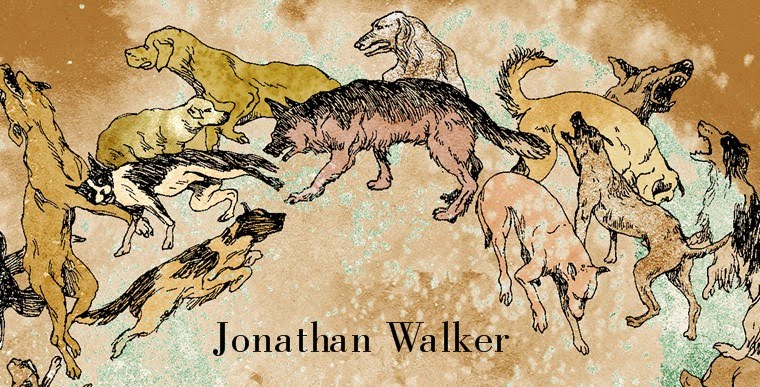
The earliest set of illustrations created for Five Wounds were the plates, which are included in the printed book as separate pages at the end of several chapters. I wrote hundreds of words of instructions to Dan for each of these. Below, for example, is the script for what is now the first of these plates, Initiation, and which concerns a character called Cur. Dan had of course already read the novel when he received this script, but for blog readers, some additional contextual information might be helpful. 

In Initiation, then, Cur has been kidnapped by dogs, and is being introduced to their group in a quasi-magical ritual. Also of relevance is an earlier incident, in which chickens were killed by the dogs as one of them bit three fingers from the hand of Cur’s father. In my script, both the chickens and the fingers are transposed to the later scene, and the fingers also ‘stand for’ three of the other protagonists of the book, who are identifiable by coded references to heraldic colours superimposed on the different fingers.

Hence this script instructs Dan to synthesise a number of scenes from the written narrative, and also to make certain ideas explicit visually that remain implicit in the text.  

SCRIPT FOR INITIATION 

A straight down overhead shot and a ‘non-literal’ pic. A wailing, crying baby Cur is lying on his back at its centre (relatively small within the frame). Underneath him are the internal lines of a pentangle in white. It will be clear from another illustration that each of the points around the pentagram stands for one of the book’s five protagonists. The sequence (running clockwise and starting from the upper left) begins with Gabriella, then Cur (the subject of this image, whose nominal assigned place is at the apex of the pentagram), then Cuckoo, Magpie and Crow. 

The left arm of baby Cur is reaching out, grasping in the direction of Cuckoo’s point on the pentagram. Around baby Cur, the pile of overlapping, slaughtered chickens will be laid in a circle along an implied outer circle, to convert the pentagram into a pentacle. Outside this circle are three severed fingers (the middle, the third and the little respectively). You should over-size them dramatically; that is, put them at a different scale to that used for Cur and the chickens (this is not apparent on my sketch). You’ll probably also need to exaggerate the nails and possibly the joints to make it clear what they are – maybe use a blood stain where they end too. 

The fingers are to be cross-hatched in the appropriate heraldic tones: checks for black Cuckoo, towards whose finger Cur’s left hand seems to be grasping, while his right hand lies open and passive in the direction of where Gabriella’s shield would implicitly be; a blank white third finger for Magpie, and a dotted little finger for Crow. Cur’s feet appear to be kicking against the latter two as he wails and cries. 

The severed fingers should be curled over and placed casually in roughly the right place, but not geometrically aligned or pointing inwards toward the centre. 

Cur’s tears could be highlit as blank white trails to contrast with a full black trail of blood down his face that is placed at the central point in the shaving scene pic

Outside the first circle of chickens that occupies the position of the pentacle circle is a second, looser circle of intertwined dogs, of different breeds and in different postures. They don’t all have to be huge and grim and black, but no Yorkshire terriers or Chihuahuas please. Their coats should be shaded using different ‘pasted on’ corruption effects (one for each dog). 

These two circles (the inner chicken one and the doggy outer one) foreshadow the two circles of the exploding palace illustration (which in turn reference Tintoretto’s Paradise in the ducal palace). 

Reduce the outer circle to four partial arcs, one in each corner. The dogs in the circle are not seen realistically from overhead, but from varying partial viewpoints, whatever is most useful to get an intertwining effect. Lots of emphasis on teeth and tongues please. 

Fill any empty space with ‘effects’, which here should emphasize fluid, flowing, overlapping stains and discolourations: that is, they should resemble water damage, since Cur recalls this experience in later life by way of a dream of drowning.  

I also drew a crude storyboard sketch to accompany this script, which I reproduce below (click to enlarge).

Storyboard Sketch for Plate 1

Since putrefaction and decay are major themes in the book, many of the Plates are marked with signs of their own physical degradation. The term ‘effects’ in the script therefore refers to these signs, which, in this case, Dan created using coffee and tea spilled on paper. Can you predict what the finished image might look like on the basis of the script above and the sketch? This was Dan’s task: to first imagine that image, and then to create it. Below is the result.

Plate 1: Initiation  

Above: Plate 1, Initiation, from Five Wounds (click to enlarge)

Some images went through several drafts, not because of any deficiencies in Dan's execution, but because I struggled to think clearly about what the proper relationship between image and text should be, or in what way precisely the image should embody broader themes from the book. 

Below, for example, are the initial instructions for what eventually became Magpie in the forest, followed by successive revisions of the image itself, the latter interspersed with selections from my e-mails to Dan. 

 SCRIPT FOR MAGPIE IN THE FOREST 

A track through a forest (Goya trees and shadows around Magpie).). A bat above, foreshadowing the incident with the first daguerreotype. We are looking at Magpie from the side and in long shot. He is holding a mirror reflecting the moon, the same mirror that Cuckoo holds in Plate 6, Cuckoo’s reflection, but Magpie is much less dominant within the frame than Cuckoo is in Plate 6. 

Magpie is dwarfed within the skeletal, snowy landscape of trees, which are layered and compressed on different planes. He is almost lost or tangled up among the tree branches, which overlap in front of him and partially obscure him, but his head, cloak and mirror remain clearly visible, as do the sky, stars and moon in the upper third of the frame. He appears within a small break in the trees (see reference pix from Blankets and Black Hole for this effect). 

The moon should be absolutely realistic and as detailed as possible, but ‘solarized’ at its upper edge as the black sky bleeds off into ‘deteriorating daguerreotype’ effects. The moon in the mirror is miniaturized but clearly recognizable. The snow falling and in drifts between the bare tree outlines allows you to rhyme the dappled effect on Magpie’s face with black and white tonal variations in the landscape. 

Compare the Blankets pix for how to show snow, dark forest and highlit figures within. There are also various good dark forest shots in Black Hole (without snow). I attach a fantastic snow effect scene from Sin City, although note that a lot of Miller's effects rely on his omission of half-tones: i.e. everything is either pure black or pure white in each frame, which is a quite different technique to that I want for the Plates, where the tonal range is longer and flattens off towards the two extremes.  

Try and keep some the textural detail of the folds of the cloak, but have the cloak down instead of up.

Plate 10 - Version 1  

Plate 10: Version 1

E-mail dated 18 May 2006: We need a daguerreotype version of the moon, not a drawn one. For the 'solarized' effect, you may need to create a smoother texture than is possible with pen and ink, using cloning in Photoshop with a dull metallic dark grey. Anyway, see what you can do. Also, too chiaroscuro. Flatten out the midtones by adding a background layer of mid-tone grey in Photoshop.

Plate 10 - Version 2  

Plate 10: Version 2

E-mail dated 2 June 2006: Lose the bat and close up the cross-hatching where it currently is. Also, I think we need a bit more snow, especially in the central and lower areas, where it is more or less absent. You could have another go at getting an effect whereby the snow is both a distinct layer ‘on top of’ the picture space, but also continues inside the picture space and blends into a corrupt background, although I appreciate that this may not be possible. 

In addition, Magpie's left hand (the one not holding the mirror) needs greater definition of form. It is currently a bit amorphous and not very hand-like.  

E-mail dated 2 June 2006: It took me a while to register that your moon is rotated ninety degrees. The effect of this is actually rather interesting. It is completely 'wrong' from an astronomical point of view, since the moon is never lit from below but always runs through its phases along the vertical axis, and in your version its features are also all in the wrong place (for an astronomer, it will be like seeing the globe tilted ninety degrees on its axis). However, I think that perhaps it's a nice way of signalling on a subliminal level that there's something not quite right or logical about the world of FW. Everything is a bit skew-wiff - as the moon is - so in that sense it's 'right', and I'm inclined to leave it alone.

Plate 10 - Version 3  

Plate 10: Version 3

E-mail dated 8 June 2006 The grey layer is (as I read it) 'behind' the black outlines of the trees and the sky above. Add some grain / white specks, etc. to it – another different representation of snow – but this should not interfere with the black ink that makes up the tree shapes and shadow outlines or with the black sky and the moon above. 

If we divide the picture up into blocks and layers of tone and completely ignore the perspective and recession, it breaks down into: 

Foreground / top layer: drifting snow and moon 

Midground / middle layer: sky, black outlines of trees and their shadows below, Magpie in middle 

Background / bottom layer: layer of amorphous grey tone 'underneath' the drawn outlines (most clearly visible as such in the space immediately surrounding Magpie) - to which add white specks / grainy interference. 

Does this make sense? Hopefully it does. 

There were some further adjustments to the moon in the top left. The final image therefore looks like this.

Plate 10: Magpie in the forest  

Plate 10: Final Version

As a final twist in the production process, the written scene that originally inspired Magpie in the forest was actually removed from the manuscript during the structural edit. However, since I liked the image so much, I invented an entirely new scene, whose sole purpose was to provide a textual justification for the continued existence of this plate. Indeed, I frequently rewrote sections of the novel in response to Dan’s work, because the illustrations often clarified ideas that were insufficiently developed in the text, or brought things to my attention that had not occurred to me during writing. 

In retrospect, the level of detail in the scripts I wrote for the plates, as sampled above, seems excessive, although the obsession with control betrayed by this accumulation of detail had interesting aesthetic consequences. All the plates feel cramped and constrained, lacking in spontaneity (natural enough since many of them went through several drafts), but this feeling accurately reflects the world that they describe and the state of mind of the characters they depict. 

In later phases of our collaboration, however, when Dan and I had both gained confidence, my instructions were far less prescriptive. The feel of the later illustrations is therefore quite different from that of the plates, which helps to vary the tone and rhythm of the book’s visual elements. Some examples of these later scripts and illustrations can be found on Dan’s blog, where he discusses their creation from his own perspective: Jean in the Jar, The Black Dog, and The Bagatto

I look forward to seeing where our collaboration will take us next.

Five Wounds: Heraldry

In a previous post, I showed some of the sketches for the heraldic shields in Five Wounds. To create these shields, Dan and I had to learn the visual code of heraldry, which is governed by strict rules about how its various elements may be combined. These rules are analogous to a grammar. Indeed, heraldry is one of the few instances where this analogy really works when applied to a visual code. Heraldry is therefore a highly distinctive semiotic system, one might even say a uniquely pure semiotic system, and as such it represents one of the earliest historical examples of a coherent system of graphic design. 

According to the classic analysis of Ferdinand de Saussure, the signs that make up any given semiotic system can be broken down into two elements: the signifier (the actual sign, e.g. the word ‘dog’), and the signified (the concept that the sign represents, e.g. the dictionary definition of the word ‘dog’). A third possible element is the referent (the thing to which the concept refers, e.g. an actual dog), but for Saussure, language actually makes more sense if you think of it purely in terms of the relationship between signifier and signified, and exclude consideration of the referent altogether. 

What makes heraldry ‘uniquely pure’ is that it anticipates this conclusion. Nothing in heraldry claims to represent anything external to the code itself, or at least the referential aspect of the system is attenuated, as if heraldry has already evolved beyond this primitive function, which remains only in a vestigial form, like the tail on a human skeleton. 

How, then, does heraldry work? It is best understood as a code, like a computer code, which is used to generate shields or coats-of-arms. The sine qua non of heraldry is therefore the shield itself, but the most basic elements of the code, which are combined to create the shield, are the heraldic tinctures, which are split into two basic groups: colours and metals. The colours are blue (azure), red (gules), black (sable), and green (vert), although the last is used far less frequently than the first three. Some versions also add purple (purpure) to the colours, but it almost never occurs in actual historical shields. The metals are silver (argent) and gold (or), which may also be represented by white and yellow respectively. 

Every shield has one of these tinctures as its base or field, onto which are laid successive layers of additional elements – like layers in Photoshop – all of which are also assigned a tincture, and which cumulatively make up the shield. Thus the shield is always viewed as a single, combined image, but its component elements can always be broken down into a series of two-dimensional layers laid on top of one another in a predetermined order. From top to bottom, this order runs thus: field, ordinaries, subordinaries, charges. 

Ordinaries consist of geometric devices such as a bend (a diagonal stripe across the shield), a pale (a vertical stripe down the middle of the shield), a fess (a horizontal strip across the middle of the shield), a cross, a saltire (a diagonal cross), a chevron, and so on. These are all laid on top of the field, and one of their functions is to subdivide it, so that their proportions in relation to the total area of the shield are therefore strictly controlled. For example, a pale or a fess should occupy roughly one-third of the shield’s area, while a chevron should occupy roughly one-fifth. Subordinaries are also geometric devices. They include the chief (a horizontal strip across the top third of the shield), the canton (a small square in the dexter chief, i.e. the top left from the viewer’s perspective [1]) and the bordure (a thin border around the shield’s outer edge). 

The final layer is that of pictorial charges. The most common of these are lions and eagles. Charges do have a notional referent, but they are always rendered in a highly abstract manner, and their relation to actual lions and eagles, or even to the symbolic meanings conventionally associated with lions and eagles in medieval bestiaries is, in effect, ‘bracketed’: it is irrelevant for how the pictorial code actually functions. 

The field is not always an undifferentiated, single tincture. It can also be divided in various conventional ways. For example, a shield divided ‘per bend’ has its field split in two diagonally, whereas a shield divided ‘per pale’ has its field split in two vertically. 

The ‘rule of tincture’ governs the way in which tinctures may be assigned to the various layers of a shield. It states that a colour cannot be laid directly on top of another colour; nor can a metal be laid directly on top of a metal. So if the field is a metal, any ordinary laid on top of it must be a colour, while any charge laid on top of that must in turn be a metal. There are, however, some exceptions to this rule, notably that it does not apply to subordinaries, or to divisions of the field. [2]  

In heraldry, blue represents only the idea of blue, and red the idea of red, and it does not matter which specific shade of blue or red is used to embody that idea. Indeed, in the seventeenth century, when it became common practice to print compilations of coats-of-arms in black-and-white reproductions, a system of cross-hatchings was invented to represent the tinctures, and these cross-hatchings represent their respective associated pigments perfectly: that is, in heraldry, a regularly-distributed pattern of dots signifies the idea of gold just as adequately as any particular yellow or gold pigment can do. 

As I have described it thus far, heraldry is a purely visual system, but – to return to our metaphor of computer code – it has a written analogue, whereby a description of a shield can be created, which serves as a programme, whose output is the visual representation of the shield.

Gules, a bordure argent

So, for example, the shield above is encoded as ‘gules, a bordure argent’, which means ‘a red field with a silver border’; whereas the shield below is ‘Per pale sable and argent, on a chief vert a canton or’, which means ‘a field divided in two vertically, with black on the left and and silver on the right, which is surmounted by a green strip occupying the top third, which is in turn surmounted by a gold square in the top left corner’.

Per pale sable and argent, on a chief vert a canton or

Any written description should allow you – if it is parsed correctly – to generate the output of a correct shield with total accuracy. And as with computer code, any ambiguity in the initial command constitutes a fatal error, while any elements or aspects of the output that are not predetermined by this code are by definition irrelevant. Minute variations in the written code may have larger consequences when it is translated into a shield. For example, the first shield below is ‘argent, a bend sable’; conversely, the second is ‘Per bend, argent and sable’; the third is ‘Per bendy, sable and argent’; while the last is ‘Per bendy, argent and sable’.

Shields to illustrate Heraldry Post on Blog

According to Shaun Tan, an image only works insofar as it can't be reduced to a written description (an argument that recalls Robert Frank's insistence that a photograph should nullify explanation), but heraldry is based upon the opposite assumption. As such, it offers one possible way of exploring the relationship between word and image, which is both a recurrent theme and a practical challenge in Five Wounds.

So why did Dan and I use heraldry in Five Wounds, and to what ends? 

When I was looking for a way to represent the book’s structure visually, I needed a system with seven elements, but that in practice only made use of five them regularly: because there are five protagonists in my book, but two other characters whose status is sometimes brought into question. Moreover, of my central five characters, I needed to be able to subdivide them into two groups, of three and two respectively, because this is how their various relationships play out. 

All of this found an analogue in the heraldic code, in which there are seven basic tinctures, but only five that occur with any regularity, and of those five, there are three colours and two metals. 

This sounds suspiciously convenient. It is possible that, at an unconscious level, I was already thinking of how to relate the structure of the book to that of heraldry right from the start, so the correspondence may not be entirely coincidental. 

In any case, thinking that the heraldic code could perhaps be converted into a map of the book’s structure, I began to develop this idea by assigning a tincture to each of my protagonists: blue to the mutilated angel, Gabriella; red to the man of blood, Cur; black to the amorphous man with a wax face, Cuckoo; silver to the daguerreotypist, Magpie; and gold to the alchemist, Crow. These designations loosely follow traditional colour symbolism, so they have a logic of sorts, although such symbolism is not part of the heraldic code. 

My next step was to design five shields, one for each of the protagonists, each using the schema outlined above: that is, Gabriella’s shield has a blue field, while Cur’s has a red field, and so on; and the addition of other elements (ordinaries, subordinaries and charges) onto the field in other tinctures would then, in each case, map the various relationships between the five protagonists.

Gabriella's Coat-of-Arms

Magpie's Coat-of-Arms  

Above: Gabriella’s and Magpie’s motto shields

Along with these ‘motto shields’ (designated thus by Dan and I for obvious reasons), there is an entirely separate series of smaller shields, which open each chapter (in the first edition of the novel, there were more of these: one for each layout). These serve as a visual index of which characters appear in the chapter in question.

There are important differences between the motto shields and the index shields. The former use pictorial charges to help define the protagonists: wings for the angel, Gabriella; a wolf for the rabid Cur; the moon and stars for the nocturnal daguerreotypist, Magpie; and so on. By contrast, the index shields are purely abstract, consisting only of the field, ordinaries and subordinaries. And, whereas the motto shields use only five tinctures to refer to five protagonists, the index shields use all seven tinctures, which therefore refer to seven different characters. 

There are therefore two overlapping but separate indexical colour systems in Five Wounds: one with five elements, and one with seven elements. 

Every index shield is unique. When different chapters involve the same group of characters, and thus use the same tinctures, each of these is represented by a different shield design. And even for the chapters in which only one character appears, and which are therefore indexed with an undifferentiated shield of a single tincture, I had Dan repaint the shield every time we used it, so that the patterning of the pigment would be slightly different. 

Having gone to the trouble of learning the language of heraldry, it may seem perverse that the first thing I decided to do with it was to violate its integrity by forcing it to describe something external to itself: that is, my five (or is it seven?) protagonists. In Five Wounds, then, the language of heraldry is persistently construed wrongly. Dan and I deliberately created ‘ungrammatical’ visual statements, which are the inevitable consequence of forcing the code to express things it was never intended to express. 

There are, for example, several index shields that violate the rule of tincture by combining colour with colour and metal with metal, depending on which characters happen to appear in any given chapter: that is, according to a criterion that is entirely irrelevant to the internal logic of the code. 

Forcing heraldry to perform such an unnatural function creates interesting problems, which were highlighted for me when I tried to encode the motto shields I designed for the five protagonists in written descriptions thereof. Below is the horrific result of this exercise, which illustrates the impossibility of trying to describe a series of (deliberate) mistakes using a code whose entire purpose is to eliminate ambiguity. It can’t be done.

Motto Shield Descriptions  

Above: A failed attempt to provide written descriptions for the five motto shields

This unreadable attempt at definition is not included in Five Wounds, but it inspired one of several handwritten annotations added to the text of the first edition of the novel, in which a garbled representation of the five motto shields (drawn by Dan) is accompanied by the cryptic note, The problem with a perfect notation system: It can’t describe an error. Of course, this observation has much broader implications in the context of the novel than its application to heraldry.

The problem with a perfect notation system  

Above: annotation from the end of the first edition of Five Wounds

However, I've cut this from the second edition, as, besides being beyond my powers to incorporate when I re-typeset the text, it also seemed a little too cute.

If a work is to be coherent, then certain ideas have to present in its DNA: they have to run through every aspect of its narrative and presentation. In Five Wounds, these ideas include: translation, garbled transmission, insecure attributions of meaning, the relationship between signal and noise, the nature of interpretation, and what constitutes a misinterpretation. It should be obvious how the book’s use – and abuse – of heraldry helps to dramatise some of these themes. 

If the colours represent the book’s protagonists, they also necessarily oversimplify their interactions by rendering them in diagrammatic form. Thus the colour coding is not only a misinterpretation because it makes improper use of heraldry: it is also a misinterpretation because, in doing so, it reduces each of the characters to a single, deterministic attribute. 

None of this would be of any interest, of course, unless the heraldic shields communicate something to the viewer emphatically and immediately, as images; but that is the advantage of using a visual code designed to do exactly that. 

Postscript: At some point, I'll provide a separate explanation of why Dan’s colour renditions of the shields are painted (deliberately) incompetently, with the paint spilling over the borders indicated by the underlying patterns. Also, see here for another short analysis of heraldry as a semiotic system.

[1] ‘Dexter’ actually designates the right-hand side of the shield, and ‘sinister’ the left-hand side, but these are determined from the point-of-view of the fictional person holding the shield out in front of them towards the viewer. I have therefore simplified matters by sticking to the viewer's point-of-view here. This account of heraldry is also simplified in other respects.  

[2] It does not apply to divisions of the field in theory. In practice, I have never seen a divided field that does not alternate a metal and a colour for the division.
Five Wounds: Heraldry Sketches

There is a more detailed post on heraldry on the way, but in the meantime, here are some of my original sketches for the miniature shields that appeared on each double-page spread in the first edition of Five Wounds. The finished versions of these indicated in colour-coded form which characters appeared on any given layout. 

In the second edition, I changed this aspect of the design. Now there are a smaller number of these shields, one per chapter instead of one per layout, but again on the same principle: that the shield at the beginning of each chapter indicates in colour-coded form which characters appear in that chapter.

Heraldry Sketches for Five Wounds 1 Heraldry Sketches for Five Wounds 2 Heraldry Sketches for Five Wounds 6 Grid of Index Shields for Five Wounds (draft)

Five Wounds: An Anti-Historical Novel, Part 2

[Historians] have always … written in the mode of magical realism. In strictly formal and stylistic terms, a text of social history is very closely connected to those novels in which a girl flies, a mountain moves, the clocks run backwards, and where (this is our particular contribution) the dead walk among the living.  

Carolyn Steedman, Dust, p. 150  

This was a psalter in whose margins was delineated a world reversed with respect to the one to which our senses have accustomed us. As if at the border of a discourse that is by definition the discourse of truth, there proceeded, closely linked to it, through wondrous allusions in aenigmate, a discourse in falsehood on a topsy-turvy universe, in which dogs flee before the hare, and deer hunt the lion.  

Umberto Eco, The Name of the Rose, p. 69  

In an earlier post, I described Five Wounds as an ‘anti-historical novel’. It relates to early modern Venice, the subject of my historical research, in much the same way as the marginalia in an illuminated manuscript relate to the sacred text that they accompany: except that in this case the sacred text, which alone justifies the marginalia, is absent or has been rewritten in a profane form. Here, then, the marginalia are promoted to the centre of attention, where they blasphemously assume the outward form of Scripture (I mean that the text is typeset in imitation of the Bible). 

In the quotation from Umberto Eco above, the topsy-turvy world in the margins is related to the central reality of Scripture through the lens of mockery. Mockery also has a central place in Five Wounds, but violence is an equally important organising principle. So the novel literally describes a violent world, in which mutilations and murders are commonplace, but that violence is not restricted to the events described in the plot. The novel’s mode of representation is also violent, in that it deliberately misrepresents historical sources: it forces them to say things that they did not intend. 

The action of Five Wounds is set in an unnamed city that is obviously a version of Venice, but is equally obviously not the historical Venice. Rather, it parodies selected aspects of that historical context, in a manner that sometimes draws upon the so-called ‘anti-myth’ of Venice, in which the Venetian state is portrayed as a corrupt, disguised tyranny rather than a virtuous, transparent republic (the anti-myth also underlies my first book Pistols! Treason! Murder!, which is a biography of a Venetian spy). In Five Wounds, there are also numerous garbled references to Venetian topography, including (notably) the Ghetto, which is here occupied by dogs, and is on the site of an abandoned foundry, this last taking up an etymological speculation about the origin of the word, ‘Ghetto’, and rendering it literally. If Five Wounds is set in several different historical periods simultaneously, as I suggested in that earlier post, then perhaps we might ask, Which, and in what proportion?

Much of the setting seems to be, roughly, mid-nineteenth century: dagurerreotypes, gas lighting, top hats. But some people wear eighteenth-century-type clothing. And the city's constitution parodies that of the Venetian republic, which ceased to exist in 1797. With regard to the book’s conceptual universe, there are references to theoretical arguments put forward by a variety of early modern thinkers, for example Machiavelli and Paracelsus; to early modern theories about the physiological origins of anger and rabies; to Neoplatonic debates on the meaning of hieroglyphs (which are garbled interpretations, based on erroneous premises); and so on. Moreover, a large painting of Paradise in the ducal palace, based on one created by Tintoretto (or his son and workshop) in the late sixteenth century, is newly painted and installed in the novel.

Similarly, some of the more complex illustrations (the plates, which appear at the end of selected chapters) incorporate photographic elements and textures into images that otherwise resemble etchings: that is, they superimpose two quite different image-making technologies.

This game of historical mix-and-match bears some resemblance to what anthropologists and cultural theorists call ‘bricolage’, a sort of ‘do-it-yourself’ attitude to culture, in which a world is made out of borrowed odds and ends, which are put to use without much interest in their original or intended function. Bricolage replaces the idea of misinterpretation with that of appropriation. Misinterpretation presupposes an original meaning that retains priority over all subsequent readings. It excludes unbelievers and heretics. By contrast, appropriation permits anything. It knows no sin. Its only law is, 'Do what thou wilt'. 

I remain committed to the idea of misinterpretation, if only because a world without sin - without laws - is profoundly boring. We are told that it is possible to deconstruct any literary text: to force it to the point of self-contradiction. But Five Wounds positively invites you to do this. It it does not really make sense, and in particular it does not make sense when considered from a historical point-of-view, but it is not even internally consistent. 

This superimposition of contradictory references is also apparent in the plot, which culminates with two alternative endings, a state of affairs that is foreshadowed throughout the book, especially in the illustrations. Thus the hand icon on the cover, which is inspired by an illustration from a seventeenth-century treatise on palmistry, presents to the viewer mutually exclusive readings: that the bearer will live long, and die young; that he will die by fire, and by drowning; and so on.

Five Wounds Hand

Above: the Five Wounds hand

This doubling  to a character named Cuckoo, who is, in certain respects, the central figure in the book. He is a gambler with a face made of wax, which he manipulates freely. It is his fate that is at stake in the two different endings, and he is therefore represented as doubled in several images, i.e. as a copy of himself. At the heart of this fictional world, then, there is a vacuum. Everything it requires to sustain stable meanings has been erased, or is ‘under erasure’ - simultaneously asserted and denied, like a phrase that is crossed out but still remains visible - a condition that is again alluded to in the person of Cuckoo, who is always represented in the illustrations with his face scratched out.

Cuckoo the trickster  

Above: Cuckoo the trickster

What is the point of all this? It is an attempt to explore the limits of historical explanation by violating all of its essential preconditions. It is also an exploration of the nature of interpretation. As such, Five Wounds opposes a book like The Da Vinci Code, which does not admit the possibility of error in interpretation. In The Da Vinci Code, this means this, and that means that; therefore this, with all the seductive inevitability of a false syllogism. In Five Wounds, mistakes are what drive the plot, or rather, the characters never know whether or not their interpretations are correct.

Even blasphemy admits of too much certainty. Self-contradiction is the only honest strategy.

[All illustrations are by Dan Hallett.]

Five Wounds: An Anti-Historical Novel

Part of the violence of Five Wounds consists in its deliberate misrepresentation of historical source material. 

I began writing it while researching for my doctoral thesis in the Venetian state archive. In the daytime, I faithfully transcribed documents. After dark, I wrote the opening chapters of Five Wounds under a bare light bulb in a rented room on the Lido, while listening to morbid folk songs on a cheap cassette recorder. Everything that had to be repressed in my interminable investigation of ‘Honour and the Culture of Male Venetian Nobles, c. 1500-1650’ bubbled to the surface in Five Wounds

In the daytime, I tried to produce an original and profound but nonetheless humble contribution to knowledge, in which the relevant authorities were cited respectfully, and the sources itemised rigorously. It was assembled piecemeal and agonisingly slowly, as all theses are, with endless rearrangements, additions and revisions. At night, I wrote straight through, without hesitating, and more or less without revision. 

The results were vulgarly derivative, as all fairy tales should be. 

Five Wounds was therefore conceived of as a deliberate insult to the notion of scholarly integrity in much the same way that a dream is an insult to the idea of conventional narrative structure. Its many historical references and quotations from abstruse treatises are systematically unreliable. Each is misleading or garbled in some way and the historical setting has been knowingly contaminated; not only by fantasy, but also by deliberate anachronism. To put it another way, Five Wounds is set in several different historical periods simultaneously, none of which are represented accurately.  

Five Wounds is not, therefore, a historical novel. Rather, it is an anti-historical novel. It is the book that my Ph.D. thesis was dreaming when it was asleep. 

UPDATE: I have added some further discussion on this theme.

Thursday, July 21, 2011

Guest Post at Spike Magazine

Spike Magazine in the UK have now published a guest post I wrote for them on the design of Five Wounds. Below is an extract:

Imagine that the appearance of a book is part of the story it tells, as if it was an artefact created by the imaginary civilisation it describes. Book design becomes an aspect of what the science-fiction community calls ‘world-building’, and as such it applies the principle of ‘Show, don’t tell’ to the surface of the page itself. My fantasy novel Five Wounds uses design in exactly this way.

Thanks to Jason Weaver of Spike for arranging this.

Monday, July 18, 2011

Some Further Comments at 'Shelf Abuse'

I somehow missed some further remarks on Five Wounds by Carl Doherty of the 'Shelf Abuse' site, who concludes:

I couldn’t recommend Five Wounds: An Illuminated Novel more. An accomplished, multifaceted work that follows the twisted fates of five sympathetic freaks in what is essentially an alternate-history Venice, its synthesis of words and images is effective enough to change anyone’s preconceptions about them thar picture books.

See here for a more detailed review by Carl. I also wrote a guest post for 'Shelf Abuse' on the influence of comic books on Five Wounds.

Thursday, May 12, 2011

Guest Post at The Spectator Book Blog

I have a guest post up at The Spectator book blog, which is about the influence of the King James Bible (published 400 years ago this month) on the design of Five Wounds

Here's an extract: 

 The modern paperback is not a natural object. The advent of e-books has made this painfully obvious. In the current state of confusion as to what a book is or should be, it might be an opportune moment to review the sacred prehistory of the novel. Five Wounds reaffirms the relevance of the King James Bible to modern storytelling, but it also draws on medieval traditions that were erased in 1611, just as the novel erased its own sacred origins.

Tuesday, May 10, 2011

Five Wounds: Discussion at 'Caustic Cover Critic'

James Morrison of the book design blog Caustic Cover Critic (he is also the publisher of Whisky Priest Books) has posted a short discussion of Five Wounds, including some photos of page layouts. Have a look!

Monday, November 22, 2010

Podcast on the Design of Five Wounds

The podcast of my talk on the design of Five Wounds, originally delivered to the Centre for the Book at Monash University on 20 Oct., is now available to download if anyone wants to listen to it at home. Alternatively, I have also uploaded and embedded the audio below.


The original talk was of course accompanied by illustrations. I have posted the most important of these below. The numerical headings are time cues, which refer to the point in the audio file at which I discuss the image in question. Anyone who wants to get a sense of what the book looks like before listening to the talk can check out these short videos, in which I flip through a copy and explain the various elements.

4:55: Freud Caricature

Freud Caraicature: What's On a Man's Mind


6:40 : Synaesthetic Paradise Diptych [I can't get this double image to work in the audio, and I waste a couple of minutes fiddling about with it]:

Synaesthetic Paradise (left panel)

Synaesthetic Paradise (right panel)


10:55: Plate 6: Cuckoo's reflection.

Plate 6: Cuckoo's reflection


12:00: Alternative Representation of Cuckoo's Face

Annotation


13:50: Gabriella's Shield

Gabriella's Coat-of-Arms


13:57: Magpie's Shield

Magpie's Coat-of-Arms


15:00: Heraldry Sketches

Heraldry Sketches for Five Wounds 1


15:15: Heraldry Grid

Grid of Index Shields for Five Wounds (draft)


15:40: Sample Page Layout [see also 18:30 for discussion of the illustration included within this sample page]

Five Wounds Sample Layout (right)


17:00: Running Head [N.B. The pages above and below are two sides of the same layout, and thus the running head below serves as a title card for the illustration on the page above.]

Five Wounds Sample Layout (left)


24:55: Geneva Bible Page Layout (1560)

1560 Geneva Bible


25:00: King James Bible Page Layout (1611)

1611 King James Bible


25:30: Modern Bible Page Layout

Modern Red Letter Bible


40:00: Plate 15: Cut me

Plate 15: Cut me

[All illustrations except the Freud caricature, the heraldry sketches and the page layouts are by Dan Hallett.]

Tuesday, October 12, 2010

Seminar at Monash University on 20 Oct.

Cover image for Five Wounds

Next week I shall be giving a talk sponsored by the Centre for the Book at Monash University on the design of Five Wounds. The talk will discuss in more detail some of the issues introduced in these videos, and will also explain the ways in which Five Wounds draws upon the history of the printed Bible.

Details are below:

Wednesday 20 October 2010
5.45 – 7.15 pm

McArthur Gallery, State Library of Victoria, Swanston Street, Melbourne CBD

(Directions to the McArthur Gallery at the SLV: walk through main ground-floor reading room, take the stairs adjacent to central lifts to Cowen Painting Gallery [level 2A], walk straight across into the Redmond Barry Reading room, then look right for the double glass doors "Maps, Rare Books etc." If any problems, ask staff on the main reference desk)


Attendance is free and everyone is welcome.

Thursday, September 9, 2010

Five Wounds: Review at Smṛti-Śruti

A very positive review at the blog Smṛti-Śruti (is that Icelandic?), whose author has done lots of research on Dan, Zoe and I. An extract below:

Images and little details within: the excellent cartouches throughout; the Solomonic columns with spectacular capitals and how almost inky black foreground column is; the Rota Fortunae of characters with Crow in his appropriate place; Cur's harrowed reflection on the blade; pipework winding through the text during the banquet; the curlicue of the candle holders and the efficient linework used to indicate the direction of light outside Cuckoo's bedroom door; the fencing diagrams; Cuckoo's seduction scene; Gabriella a replica of a classical Venus in Magpie's dream - excellent.

My favourite piece of art is the beautiful bit of marbling, a mushrooming red blotch against the milk white of the page particularly because it was such a simple but bold and perfect visual analogue for the text.


Annotation

Wednesday, June 16, 2010

Five Wounds: Review at 'Vibewire'

Thanks to reviewer Dave Drayton for this very generous write-up at Vibewire. An extract is below.

The five senses are a common theme in Five Wounds and it seems fitting then, that it appeals to the senses in such detail. I have literally tried everything short of licking the book. The hardcover, thoughtful selection of paper stock and red ribbon page-marker makes the book seem like an artefact; it is a privilege to hold it. .... The scribblings peppered through out the book add to its mystery. I feel as if I am reading a diary, a draft, a spell book; something personal that was not meant for the eyes of others. .... [They] lend the book a desperate sense of urgency.

Tuesday, May 25, 2010

Inspirations: William Blake

When I pitched the idea of an 'illuminated novel' to Erica Wagner of Allen & Unwin in late 2008, I used the example of William Blake's 'illuminated books' as a historical precedent: editions of Blake's poetry, in which the words were incised calligraphically on engraving plates, where they were accompanied by Blake's own illustrations. In many cases, the printed copies were also painted by hand afterwards in watercolour. However, when Dan and I were working together to create Five Wounds, I found Blake's illustrations for Dante's The Divine Comedy and The Book of Job more useful, perhaps because these raise the issue of collaboration and interpretation more explicitly, but also because (to be honest) I find much of Blake's own poetry unreadable.

The following are from the illustrations for Dante's The Divine Comedy. The first is Dante running from the three beasts (the Leopard, Lion, and She-Wolf respectively from the bottom up); the second is the Wood of the Suicides:

William Blake, Dante Running from the Three Beasts

William Blake, The Wood of the Suicides

The following are from Blake's illustrations for The Book of Job. The first is Behemoth and Leviathan; the second is the original watercolour of the same on which the engraving is based; the third is Job's Despair; the fourth is The Lord Answering Job out of the Whirlwind:

William Blake, Behemoth and Leviathan

William Blake, Behemoth and Leviathan Watercolour

William Blake, Job's Despair

William Blake, The Lord Answering Job out of the Whirlwind

We did consider framing the Plates in Five Wounds in a similar manner to the way that these engravings for the Book of Job have been surrounded with text, but in the end we felt that it might have been too much in the context of the novel. It is, however, an idea I intend to return to.