height

Monday, November 29, 2010

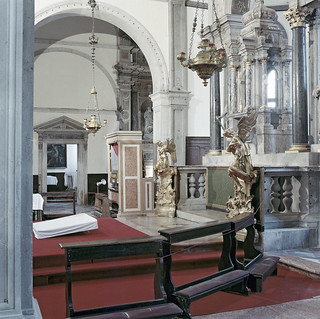
Santa Maria Formosa, Venice, 2002

Santa Maria Formosa, Venice, 2002

I had about forty-five minutes inside the church of Santa Maria Formosa before the light went. I shot eight frames (I think), of which this is the best – though that's not saying much. What was I looking at? I remember noting the following (in no particular order):

1) The light in the window on the right shining through the columns of the altar.

2) The red of the carpet, the green on the front of the altar and the mottled, pinkish organ booth. If a space is not articulated by contrasts in the distribution of colour, then there’s no point in using colour film.

3) The two prominent hanging lamps, which represented a problem that I was unable to solve to my complete satisfaction (so that their current positions within the frame were a compromise).

4) The golden angels, and in particular the fact that one of them is being ‘stabbed’ in the head by a partially-visible statue on the altar behind.

5) The position of the column at the left in the foreground relative to the pediment of the doorway in the background.

6) The four objects covered in white cloths on the left side of the frame. (What exactly is the tilted object on the floor? I don’t know and it bothers me.)

7) The difference in the source and intensity (and hence the colour) of the light through the doorway on the left. I was less aware of the patch of cold light at the bottom right and I didn’t notice the colour shift in the column on the left at all. The latter effects are stronger on the film than they appeared to the naked eye.

8) The red thread running around the benches, which is a more delicate but more absolute boundary of the space within than the benches themselves. And it is somehow important that the thread is red. (N.B. The thread may not be visible in the miniatruzed version above.)

9) The figure in the painting through the door on the left. It was important to show all of it. (The figure is also difficult to see in the version here.)

The list could be extended – but never to the point where it includes everything in the frame.

Thursday, November 25, 2010

'Tree of Codes' by Jonathan Safran Foer


Tree of Codes
is Jonathan Safran Foer's new book, which is a 'treated' edition of The Street of Crocodiles by Bruno Schulz, in the spirit of Tom Phillips' A Humument. It is published by Visual Editions. There's a good interview with Safran Foer in the NYT (extract below).

Q.Where did this strong affinity for graphic design come from?

A.Where would the lack of interest in design come from? Why wouldn’t — how couldn’t — an author care about how his or her books look? I’ve never met an artist who wasn’t interested in the visual arts, yet we’ve drawn a deep line in the sand around what we consider the novel to be, and what we’re supposed to care about. So we’re in the strange position of having much to say about what hangs on gallery walls and little about what hangs on the pages of our books. Literature doesn’t need a visual component — my favorite books are all black words on white pages — but it would be well served to lower the drawbridge
.

Monday, November 22, 2010

Podcast on the Design of Five Wounds

The podcast of my talk on the design of Five Wounds, originally delivered to the Centre for the Book at Monash University on 20 Oct., is now available to download if anyone wants to listen to it at home. Alternatively, I have also uploaded and embedded the audio below.


The original talk was of course accompanied by illustrations. I have posted the most important of these below. The numerical headings are time cues, which refer to the point in the audio file at which I discuss the image in question. Anyone who wants to get a sense of what the book looks like before listening to the talk can check out these short videos, in which I flip through a copy and explain the various elements.

4:55: Freud Caricature

Freud Caraicature: What's On a Man's Mind


6:40 : Synaesthetic Paradise Diptych [I can't get this double image to work in the audio, and I waste a couple of minutes fiddling about with it]:

Synaesthetic Paradise (left panel)

Synaesthetic Paradise (right panel)


10:55: Plate 6: Cuckoo's reflection.

Plate 6: Cuckoo's reflection


12:00: Alternative Representation of Cuckoo's Face

Annotation


13:50: Gabriella's Shield

Gabriella's Coat-of-Arms


13:57: Magpie's Shield

Magpie's Coat-of-Arms


15:00: Heraldry Sketches

Heraldry Sketches for Five Wounds 1


15:15: Heraldry Grid

Grid of Index Shields for Five Wounds (draft)


15:40: Sample Page Layout [see also 18:30 for discussion of the illustration included within this sample page]

Five Wounds Sample Layout (right)


17:00: Running Head [N.B. The pages above and below are two sides of the same layout, and thus the running head below serves as a title card for the illustration on the page above.]

Five Wounds Sample Layout (left)


24:55: Geneva Bible Page Layout (1560)

1560 Geneva Bible


25:00: King James Bible Page Layout (1611)

1611 King James Bible


25:30: Modern Bible Page Layout

Modern Red Letter Bible


40:00: Plate 15: Cut me

Plate 15: Cut me

[All illustrations except the Freud caricature, the heraldry sketches and the page layouts are by Dan Hallett.]

Wednesday, November 17, 2010

Sydney Freecon, 19-21 November 2010

This weekend I shall be participating in the Sydney Freecon, organised by Garry Dalrymple of the Sydney Futurians. There will be several events featuring local science-fiction / fantasy / horror writers, all taking place in Bankstown public library or nearby. As the name implies, there is no charge for attendance.

I shall be there on Friday evening (when I shall be giving a short reading) and Saturday afternoon (when I might possibly be available for a 'kaffeeklatsch' open discussion with other attendees, depending on interest).

The current draft programme is here.

Friday, November 5, 2010

Five Wounds: Review at 'Transnational Literature'

The latest issue of the academic e-journal Transnational Literature includes a review of Five Wounds, written by Aliese Millington. An extract is below: Think back to your first trip with Alice tumbling down the rabbit hole, or how it felt to enter the Matrix after Neo takes the red pill. Five Wounds: An Illuminated Novel takes you down a similarly twisting path and leaves you pondering the journey well afterwards. Pooling influences trans-national, trans-cultural, trans-temporal and transart form, authors Jonathan Walker and Dan Hallett spin the story of ‘five wounded orphans [who] must face their traumatic origins’ (blurb). These tales are told through the fascinating combination of Walker’s proclamatory prose, Hallett’s Goya and comic-book influenced illustrations, a Bible-like layout and handwritten notations. Described as ‘cruel and arbitrary’ (blurb) by the authors, the world of Five Wounds looks and feels at once early renaissance, modern and apocalyptic. I am particularly pleased to see a review in a journal on transnational literature, since many of the sources for Five Wounds are Italian: notably, Italo Calvino and Tintoretto. Below is a selection of transnational sources taken from a detail of an illustration (by Dan Hallett) on p. 100 of the novel.

Transnational Literature

Monday, November 1, 2010

Mornings

[Originally posted on the Melbourne Writer's Festival blog:]

At this hour of the morning,’ he said, addressing nobody in particular, ‘people who are awake fall into two categories: the still and the already.

So says a character in Italo Calvino’s story ‘The adventure of a wife’ to the protagonist, who has wandered into a cafe at six a.m. She, like the speaker, falls into the first category, since she is on her way home after being out all night.

In 1994, I was up at six a.m. almost every morning, but for the first part of the year I was a ‘still’ and in the second part I was an ‘already’. In the 'still' part of the year, I worked on the night shift as a security guard at a cardboard factory. (I think that’s what they made. I didn’t really care, so I never bothered to find out). In the 'already' part of the year, I worked as a postman, and I started work at 5.45. In both jobs I set a record of sorts: I had the longest hair of any security guard in Glasgow that year; and later I was the slowest postman in the entire city.

I became a connoisseur of tiredness during this period. The first critical distinction to be made on that subject is related to Calvino’s observation, since the tiredness of staying up too late is qualitatively different from the tiredness of getting up too early.

Saturday, October 23, 2010

Guest Post on Literary Minded

The blog Literary Minded has now posted a short essay I wrote about watching Christine Edzard's film of Little Dorrit. An extract is below.

In the Summer of 1989, I left my father’s home, which was never my home, not after my mother died. I couldn’t stand it there, in my father’s home, in the dark there, with the recessed windows and the ceilings, so low I used to bang my head on the doorjambs. The smell was what really used to get to me, as if it had seeped into the stone floors.

Child of an unfortunate father.

In the Summer of 1989, I left my father’s home, which was no longer my home. I left for Liverpool, knowing that I would only be there a few months, until I went north to university in October. I had no job and no money, but an older friend had just bought a gutted house that he was planning to renovate. I could stay there in one of the upstairs bedrooms.

A delicate appeal for a small temporary accommodation.

Tuesday, October 12, 2010

Seminar at Monash University on 20 Oct.

Cover image for Five Wounds

Next week I shall be giving a talk sponsored by the Centre for the Book at Monash University on the design of Five Wounds. The talk will discuss in more detail some of the issues introduced in these videos, and will also explain the ways in which Five Wounds draws upon the history of the printed Bible.

Details are below:

Wednesday 20 October 2010
5.45 – 7.15 pm

McArthur Gallery, State Library of Victoria, Swanston Street, Melbourne CBD

(Directions to the McArthur Gallery at the SLV: walk through main ground-floor reading room, take the stairs adjacent to central lifts to Cowen Painting Gallery [level 2A], walk straight across into the Redmond Barry Reading room, then look right for the double glass doors "Maps, Rare Books etc." If any problems, ask staff on the main reference desk)


Attendance is free and everyone is welcome.

Saturday, October 9, 2010

Tristram Shandy by Visual Editions

VE1 Tristram Shandy from Visual Editions on Vimeo.

Visual Editions manifesto:

We think that books should be as visually interesting as the stories they tell; with the visual feeding into and adding to the storytelling as much as the words on the page. We call it visual writing. And our strap line is “Great looking stories.”

Monday, September 13, 2010

Inspirations: Cattle and the Creeping Things by The Hold Steady


For the effortless way in which it integrates Biblical stories and idioms into a resolutely secular narrative. And for this genius theological analysis:

I GUESS I HEARD ABOUT THE ORIGINAL SIN
I HEARD THE DUDE BLAMED THE CHICK
I HEARD THE CHICK BLAMED THE SNAKE
I HEARD THEY WERE NAKED WHEN THEY GOT BUSTED
I HEARD THINGS AIN'T BEEN THE SAME ROUND HERE SINCE

Saturday, September 11, 2010

Inspirations: A Matter of Life and Death by Powell and Pressburger (1946)


I saw A Matter of Life and Death on television in the 80s, and finally on a cinema screen in repertory in the early 90s at the GFT in Glasgow. Its current interest for me lies partly in its allegorical mode of storytelling, and its emphasis on production design in the service of this mode, as suggested in Ian Christie's essay on the film in the BFI Film Classics series (pp. 16, 18-19):

[A Matter of Life and Death is a] striking example of the reinvention of the masque. This form of spectacle, combining elements of verse drama, dance, music, scenery and costume, was popular in aristocratic and court circles in the sixteenth and seventeenth centuries. Masques were usually allegorical, with a mythological scenario which could also be read in terms of contemporary politics. The court masque reached its height during the reign of James I, with the playwright Ben Jonson developing its dramatic structure by adding a comic prelude or 'anti-masque', and the architect Inigo Jones using the almost unlimited funds available to introduce for the first time all the machinery of modern theatre - artificial lighting, moveable sets and magical effects - to create 'pictures with Light and Motion'. ....

It is by means of ... mythic association, together with the invocation of motifs from the two Shakespearian 'magic' plays, A Midsummer Night's Dream and The Tempest, that A Matter of Life and Death creates its masque-like story. Its characters are indeed not realistic individuals, even by the standards of 40s cinema, but are emblematic and allegorical: the Poet, his Beloved, the Heavenly Messenger, the Magician. They move in equally symbolic spaces: the Other World; and on earth, the Seashore, the Wood, the Palace, and that modern temple of mysteries, the hospital. And the machinery of the spectacle - most notably the giant escalator and the celestial amphitheatre, but also such an ultra-filmic effect as the giant eyelid closing over the screen under anaesthesia - is as important as were Jones's stage 'machines' for Jacobean masques.

Throughout, A Matter of Life and Death shifts backwards and forwards between purely allegorical, or fantastic, scenes, and melodrama: that is, heightened realism, which is, in its deliberate exaggeration, equally contrived. For example, in the clip above, note the implausible isolation of Kim Hunter's character on a dark set lit principally by a lurid red offscreen source, and the presence of an exaggerated ticking clock on the soundtrack, not to mention the dialogue, which flirts with absurdity, notwithstanding the absolute conviction with which David Niven delivers his lines, and their undeniable emotional impact. But all this is still within the bounds of realism, unlike the film's distinctive representation of the afterlife. The clip below follows on immediately after the one above.


Similarly, Five Wounds combines highly abstract elements with Grand Guignol violence.

PROP OR WINGS?

Thursday, September 9, 2010

Five Wounds: Review at Smį¹›ti-Śruti

A very positive review at the blog Smį¹›ti-Śruti (is that Icelandic?), whose author has done lots of research on Dan, Zoe and I. An extract below:

Images and little details within: the excellent cartouches throughout; the Solomonic columns with spectacular capitals and how almost inky black foreground column is; the Rota Fortunae of characters with Crow in his appropriate place; Cur's harrowed reflection on the blade; pipework winding through the text during the banquet; the curlicue of the candle holders and the efficient linework used to indicate the direction of light outside Cuckoo's bedroom door; the fencing diagrams; Cuckoo's seduction scene; Gabriella a replica of a classical Venus in Magpie's dream - excellent.

My favourite piece of art is the beautiful bit of marbling, a mushrooming red blotch against the milk white of the page particularly because it was such a simple but bold and perfect visual analogue for the text.


Annotation

Wednesday, August 25, 2010

My Worldcon Schedule

From 2-6 September, I shall be attending, and participating in, the annual Worldcon meeting of the World Science Fiction Society, which this year takes place in Melbourne. There are some big names in the field taking part: the guests of honour include Kim Stanley Robinson and my fellow Allen & Unwin author Shaun Tan.

The full programme is here. I am appearing on several panels, and will also be doing an individual reading and signing, and a 'kaffeeklatsch' (an informal meeting between an author and a small group of interested persons). My panels include the following:

Thursday 2 Sept., 1600, Room 204: Steal the Past, Build the Future: New Histories for Fantasy Fiction

Many fantasy novels and stories base themselves around a medieval European setting. Others tread a little further from such comfortable territory, presenting worlds inspired by 18th century Paris, or 11th century Viking sagas, or Ancient Rome and Egypt. What’s left? What are the creative opportunities and historical settings lying in wait from which authors might draw inspiration?

Amanda Pillar, Catherynne M. Valente, Jonathan Walker, Kate Elliott


Thursday 2 Sept., 1700, Room 219: If you wrote it, they wouldn’t believe it

Maintaining realism and ensuring readers believe what is happening are all-important considerations when writing fiction - but when did real life ever consider its readers? A look at the significant moments in history so unlikely that, despite having actually happened, nobody would believe them in a fictional story.

Tansy Rayner Roberts, Jennifer Fallon, Gail Carriger, Jonathan Walker


Monday 6 September, 1000, Room 204: From ideas to images: Illustrating SF

When creating illustrations to accompany prose fiction, the artist is given a balancing act between finding a way to accurately express the author’s prose in visual terms and expressing his or her own creativity and artistic style in the
same way. How do different artists approach the art of illustrating fiction, and what are the benefits and drawbacks of that collaborative process?

Andrew McKiernan, Nick Stathopoulos, Shaun Tan, Bob Eggleton, Jonathan Walker


Monday 6 September, 1400, Room P1: Counterfactuals: Science fiction vs historical analysis

What role can alternate history fiction play in historical analysis? By examining the potential after-effects of a fictionalised course of events, do we gain a fresh and valuable perspective on what actually happened? If so, what requirements exist for alternate history fiction to achieve this aim? A look at alternate history fiction from two perspectives: as science fiction readers, and as historians.

Kim Stanley Robinson, Gillian Polack, Dena Taylor, Jonathan Walker


My individual events are as follows:

Friday 3 September, 1200, Rm 201: Kaffeeklatsch

Numbers are limited to nine, and you will need to sign up in advance, either at the Con, or by e-mail at kaffee@aussiecon4.org.au. More details here. The format of this meeting will be decided by whoever turns up for it.

Monday 6 September, 1100, Rm 219: Reading.

Mainly from Five Wounds, but I might throw in a little from Pistols! Treason! Murder! for contrast.

Monday 6 September, 1300, Rm 201: Signing.

At the same time as Charles Stross, Robert Hood and Helen Lowe.


I am a long-time reader of all things science-fiction and fantasy and comics-related, but this is my first ever Worldcon, and I am probably an unknown quantity to most of the attendees, so I am a bit worried that no-one will turn up for these latter events. If you are attending, and you enjoyed Five Wounds - or you are just curious to find out about local authors - please come along and say hello, even if you haven't read the book. Overseas visitors might want to note that Five Wounds is currently only available in Australia, so this is your chance to get an advance look at it before it's published in the US and UK next year.

For more information on Five Wounds, see my site, where you will find a free chapter and some introductory videos (the videos can also be found here).

Tuesday, August 24, 2010

Saturday, August 21, 2010

Melbourne Writers Festival Authors on ...

Federico Fellini

Dreams

Mornings (including my commentary on an excerpt from a short story by Italo Calvino)

Wednesday, August 4, 2010

Interview on 'The Comic Spot'


Above is the audio file of my recent interview on 'The Comic Spot', with John Retallick and Jo Waite, broadcast on 15 July 2010, on 3CR Radio in Melbourne. I have edited the clip so that it only includes my interview, but the full show is available to download from the podcast archive.

Tuesday, July 20, 2010

Melbourne Writers Festival: Modern Dystopia

I shall be appearing at this year's Melbourne Writers Festival, on a panel with Booker-Prize winning author DBC Pierre, whose new novel Lights Out in Wonderland is about to be published. The panel is on Modern Dystopia, and it takes place at 4 p.m. on Sunday 29 August at the Australian Centre for the Moving Image. Tickets are on sale now.

UPDATE: You can now download a podcast of this session. I have also uploaded the relevant section of the audio and added some further written discussion of the ideas raised in our discussion here.

Wednesday, July 14, 2010

Interview on 'The Comic Spot'

I will be a guest on 'The Comic Spot' radio show on 3CR in Melbourne this Thursday afternoon (15 July) at about 5.30 p.m. You can listen in Sydney via streaming (as I do!).

Monday, July 12, 2010

Five Wounds: Various Reviews

A round-up of several different reviews of Five Wounds

A very positive assessment at M/C Reviews by Samantha Hagaman (an extract below):  

It really is a case of mirrors within mirrors and themes upon themes in Five Wounds; even the very riddle-like nature of the novel’s illustrations relates to Gabriella’s stunted ability to read prophecies of the future. It requires a great scope of imagination to create an artwork such as Five Wounds, and it’s well worth taking a look and being inspired by Walker’s and Hallett’s collaboration. 

A mixed review in The Big Issue by Jen Breach (online version at her site; extract below):  

Jonathan Walker has successfully created a grubby and brutal otherwordly tone reminiscent of Patrick Suskind's Perfume. Dan Hallett's illustrations are either beautifully detailed and constrained or loose and distrubing, but always in synch with the text. 

And finally, at Radio National's The Book Show, a (more or less) negative review from Simon Keck, but one that includes the irresistible description of Five Wounds as 'nerdy historian fan fiction'.

Thursday, July 8, 2010

Inspirations: The Charge of the Light Brigade by Tony Richardson (animations by Richard Williams)


Above is a compilation of several animated sequences (created by Richard Williams), which appear in Tony Richardson's The Charge of the Light Brigade (1968). The film in general, and the animations in particular, were a big influence on my first book, Pistols! Treason! Murder! In the film, these sequences punctuate the live action sections, and provide a satirical commentary on events. Below I discuss these animations in an extract from the chapter I contributed to Historical Reenactment: From Realism to the Affective Turn (Re-enactment History), edited by Paul Pickering and Iain McCalman (see here for further discussion of this chapter).

Consider Tony Richardson’s underrated film, The Charge of the Light Brigade, made in 1968 and set during the Crimean War in the mid-nineteenth-century. Richardson is immediately faced with the challenge of authenticity. Is telling a story set in the nineteenth century by means of modern media (that is, moving pictures intended for projection upon a cinema screen) an anachronism? Most complaints on the issue of anachronism concern questions of content or mentality—the latter usually involving the attribution of modern attitudes and beliefs to historical characters. The idea of formal anachronism is rarely raised.

The Charge of the Light Brigade is punctuated with animated sequences—made by Richard Williams—that are its most brilliant coup. These are very obviously not realistic at all, at one level. On the contrary, they consist of moving allegorical tableaux that dramatise relations between the European nation-states (the English lion and bulldog, the French cockerel, the Russian bear). However, their style is realistic in the sense that it invokes the satirical cartoons from the magazine Punch or the etchings that Phiz created for Dickens’ novels—and also perhaps their eighteenth-century forebears, William Hogarth and James Gillray. Considered as pastiche, the animations are lovingly detailed, and their tone faithfully reproduces the imperialist rhetoric of the mid-Victorian era. But they are not just pastiche. Something has been added to the original sources: most obviously, the simple fact of animation, but with it has come a different attitude, a kind of detachment and self-conscious manipulation of hindsight that is (by definition) absent from the primary sources. Very quickly, the integrity of the representation is (deliberately) undermined, as unified tableaux disintegrate into collaged fragments in a way that anticipates techniques later used by Terry Gilliam in Monty Python’s Flying Circus. Anachronism is deployed as a critical technique.

For Fredric Jameson, the unwillingness or incapacity to acknowledge anachronism is one of the fundamental characteristics of pastiche. To put this in positive rather than negative terms, one of the achievements of pastiche is to actively suppress the concept of anachronism. By contrast, deliberate use of anachronism, and especially of formal anachronism, is a central feature of The Charge of the Light Brigade, in which the tension—even the contradiction—between modern methods of storytelling and the very different narrative techniques used by people in the past is a creative tension. The only unforgivable error would be to pretend that this tension did not exist–as pastiche does. History exists to map the fault lines between the past and the present, rather than to paper over the cracks.

Saturday, July 3, 2010

Pistols! Treason! Murder!: Interview on Radio National's Late Night Live

Another one from the archives: This interview was originally broadcast on Radio National's Late Night Live, in February 2007, for the Australian release of Pistols! Treason! Murder!


The interview refers to my facetious manifesto on 'punk history', as discussed here.

Thursday, June 24, 2010

Five Wounds: Review in 'The Spit Press'

The Spit Press is 'Sydney's Creative Newspaper', aimed at readers who work in, or are interested in, the creative industries. Their latest issue has a review of Five Wounds by James Scott on p. 20. It's a bit difficult to locate the text in the online version, so I have copied it below. But do check out the rest of the newspaper: it offers a unique perspective on life in Sydney.

Graphic Novels, Not Just for Geeks?

Five Wounds by Jonathan Walker and Dan Hallett is atmospheric, grotesque, thrilling and tender. Certainly unlike anything else we've ever stumbled upon, this illustrated novel is a disturbing delight. Book lover James Scott had a read.

With a beautiful hardcover this 'illuminated novel' is a fantastic book to plonk on your lap in any public place, even if only to enjoy the sideways glances of passersby who seem to suspect you might at any moment turn to them, eyes dark, and incant at them in some frightening, grunting language.

Upon opening the book I was startled and initially annoyed by what at first struck me as a pretentious and over the top way to lay out the text. That is, rather like 'The Bible', complete with verse numbers. However before long, I was totally won over by the hypnotic and addictive rhythm that reads almost like poetry.

The story is set in an imaginary Venice and chronicles the complicated intrigues of five disfigured protagonists. Gabriella is a mutilated angel who struggles to decipher her prophetic dreams. Cur is a rabid `Romulus' and aquaphobe, who knows nothing other than the cult of canine mercenaries and the ghetto in which he was raised. Cuckoo is an orphan, obsessed with chance and cards, who can reshape his wax face (less weird in context than it sounds here) to resemble another's, however cannot smile without a mirror, a candle and some time. Magpie is a sickly thief and photographer, who fears direct light for blindness and yearns for a model to surrender to him completely. Undoubtedly my favourite however is Crow; a leper alchemist. Deliciously reprehensible, Crow is ruthless and fantastically clever in pursuing his extremely ambitious goals. The stories and studies of these characters intertwine with increasing intricacy as the novel builds to an immensely exciting, haunting, heartbreaking and ultimately satisfying conclusion.

The depiction of this alternative Venice is dreamy and surreal, but the author paints a world that feels completely authentic. The illuminations by Dan Hallett are a joy, and bring a lot to the book. Sometimes striking and colourful, and at other times comical and cartoonish, they reinforce the idea that this is a fairy tale for grown ups.

The writing is extremely capable and the author cleverly uses patterns and shapes modeled not only on The Good Book but also on Grimm's Fairy Tales to give the story a familiar feel that plays well against the darkness of the plot and the sometimes slightly uncomfortable, but impressive depth in characterisation. Five Wounds is also saturated with references, saturated.

All in all, a very handsome book and a story that is symphonic in its poetry, breadth and cohesion. It is tempting to think that the author lives by the same motto as one of his characters; "Either Ceasar, or nothing."