height

Tuesday, April 27, 2010

Appearance during Free Comic Book Day at Kinokuniya, Sydney

This Saturday, 1 May, is the official release date for Five Wounds, and in the afternoon I shall be appearing as part of the Zine / Craft fair in the Sydney branch of Kinokuniya book shop, directly above Town Hall train station. See here for more details.

I'll be there to sign copies from about 1-4 p.m. I'll be the one not dressed as a Star Wars character.

There will also be a Dalek in attendance (no relation).

There will be a discount on the cover price of Five Wounds for anyone buying on Saturday.

Zoe's Thesis

The designer of Five Wounds, Zoë Sadokierski, recently finished a Ph.D. on VISUAL WRITING: A critique of graphic devices in hybrid novels, from a Visual Communication Design perspective, i.e. how to read books with pictures in them, for those of you not fluent in Ph.D. speak. The thesis is now available for download via Zoë's blog.

El Globo, Issue 1

Dan Hallett has just released Issue 1 of his comic, El Globo. I'm not sure how useful this information will prove to Australian readers (especially since the comic is in Spanish), but I thought it was worthy of commemoration.

Thursday, April 22, 2010

Pistols! Treason! Murder!: Review from History Australia

The following is another archive review of Pistols! Treason! Murder!, by Marnie Hughes-Warrington, from History Australia 5.1 (2008):

REVIEW OF JONATHAN WALKER’S PISTOLS!
TREASON! MURDER! THE RISE AND FALL OF A
MASTER SPY, MONOGRAPH AND WEBSITE

According to Iain McCalman, Jonathan Walker’s Pistols! Treason! Murder! is the ‘first true work of “punk history”’. If what is meant by ‘punk history’ is carefully stage-managed historiographical defiance, McCalman’s description is apt. At first sight, the focal point of Pistols! Treason! Murder! is Gerolamo Vano, a self-fashioned Venetian ‘general of spies’ whose life unravelled into a noose in 1622. A closer look at the text and its accompanying website, though, reveals that the work is as much about Walker’s ways of composition and historiography as it is about the shaping and pathology of self in seventeenth-century Venice.

Walker’s acknowledged sources of historiographical inspiration include Stephen Greenblatt’s Renaissance Self-Fashioning, microhistories ranging from Natalie Zemon Davis’s The Return of Martin Guerre to McCalman’s The Seven Ordeals of Count Cagliostro and Walter Benjamin’s unfinished posthumous work, The Arcades Project. Chief among these sources perhaps is The Arcades Project, for Pistols! Treason! Murder! has the form of an apparently random series of quotations, observations, notes and interviews. Between chapters 16 to 20, for instance, we pass from excerpts from the chief source of information about Vano – file 636 in the Venetian archives – to an analysis of the meaning of ‘honour’ in seventeenth-century Venice, to the purported transcript of a conversation between Walker and two other historians in an Irish pub, to Walker’s testing of Vano’s geography from a report dated 10 April 1622 and eight possible readings of it, to a comparison of the material fabric of Venice with the chief archival sources.

The ‘arcades’ flavour of the book is reinforced by the related website, which offers browsers information on the historiographical and popular cultural sources for Walker’s writing – including songs by Johnny Cash and The Afghan Whigs vivid colour pictures of the textures of Venice and most usefully, ‘deleted scenes’. The ‘deleted scenes’ include the papers Walker published on the project prior to the book, and excluded chapters on the spy as flaneur and intellectual history. These segments of the website, in combination with the marvellous central image by Hallett of the project as a tree of knowledge – and even temptation, given the representation of the link to file 636 as an apple – and the flip book sequence in chapter 28 of the book show that Walker’s project is as much a homage to and revisitation of visual as well as print culture.

Readers more accustomed to the conventional arrangement of biographical material according to a chronological or thematic scheme may find the book and accompanying website jarring. That, Walker would probably insist, is a good thing, for Vano’s activities cannot be rendered coherent. Archival gaps will not allow it, but moreover, as Walker claims:

Each story in Vano’s reports contains or opens up the possibility of another
that undoes or reverses it. Each collapses as a direct consequence of attempts
to shore it up. No possible scenario accounts for everything. As I read the reports,
I ‘crashed’ repeatedly: irretrievable error; the system has shut down. I
could not leave Vano alone, but he offered no answers to any questions that a
respectable historian might want to ask. Instead he demanded a more daring
and radical response, in which obsession itself becomes a strategy (p. 7).

This quote is important, for it highlights the differences between Pistols! Treason! Murder! and The Arcades Project. Many commentators have noted that Benjamin’s Project can be arranged and rearranged, and read and re-read in any number of different ways. Almost entirely absent from Benjamin’s Project are the motifs that individuals use to connect and therefore render their experiences meaningful. In Pistols! Treason! Murder!, there are at least three meaning-makers: Vano, Walker and the illustrator Dan Hallett. The Vano of Pistols! Treason! Murder! is engrossing and somewhat akin to the character of Tony Wilson in 24-Hour Party People, ascribing, erasing and re-ascribing meaning to peoples’ actions in order to place himself in a past that delivers respect and financial reward. In his world, a cough might signal betrayal and the promise of recognition and reward. Or it might simply be a cough. We can never be sure. The patterns of Vano’s rhetoric are intriguing, but ultimately only hinted at in the text. As Richard Evans noted in Kneipengespräche im Kaiserreich, the rhetorical form of intelligence reports is an important part of their meaning, not an obstacle to a ‘real’ individual. A closer look at Vano’s language, and the comparative analysis of other informants might suggest a more conventional individual than we can currently see.

Arguably, Walker is sketched in more depth than Vano: literally in graphic-novel illustrations provided by Dan Hallett and figuratively in his self reflections on his ‘obsession’ with Vano. Early on, for instance, he eschews Simon Schama’s Dead Certainties in favour of the multiple typefaces pioneered in works like Richard Price’s Alabi’s World. In so doing, he affirms a world in which boundaries between fact and fiction and primary and secondary sources matter. Moreover, the historiographical metaphors that he employs – the historian as pathologist and psychic – are now quite conventional and in the latter case, rest upon the problematic reading of historical understanding as an epistemological rather than conceptual activity. Has he, like the protagonist of the Radiohead song, 2+2=5 (the title for chapter 23 of Pistols! Treason! Murder!) succumbed to historiographical ‘doublethink’?

Even if the answer to that question is yes, Pistols! Treason! Murder! is still a stimulating and provocative read. It is punk history, but probably more in the tuneful style of The Jam than the manufactured chaos of The Sex Pistols.

Monday, April 19, 2010

Inspirations: Something Wicked This Way Comes by Ray Bradbury (1963)

'Heck,' said Jim.

'No such place as Heck. But hell's right here under 'A' for Alighieri'.

'Allegory's beyond me', said Jim.

'How stupid of me,' Dad laughed. 'I mean Dante. Look at this. Pictures by Mister Dore, showing all the aspects. Hell never looked better. Here's souls sunk to their gills in slime. There's someone upside down, wrong side out'.

'Boy howdy!' Jim eyed the pages two different ways and thumbed on. 'Got any dinosaur pictures?'

UPDATE: Hello to visitors from raybradburyboard.com. I first read Something Wicked This Way Comes when I was 13 or so - about the same age as its protagonists Will and Jim - and my paperback is a very yellow copy of the tie-in edition from the (rather disappointing) film version of 1983, although I had already read a library copy several months before buying it, appropriately enough, given that Will's father is a librarian, and the town library is the setting for a crucial scene. It is one of only two books from my teen years that I read through a second time immediately upon finishing it (the other one will be the subject of a subsequent post). I remember being particularly delighted by the one sentence chapter 'Nothing much happened all the rest of that night' (which I quote from memory, so I may have got it wrong). Fahrenheit 451 also made a big impression on me, and, although I have never been a big short story fan, I read several volumes of Ray's short fiction on the basis of my enjoyment of the novels.

In addition, the quotation above may be the first place I ever came across the name 'Dante'.

Sunday, April 18, 2010

Appearance at this year's Sydney Writers' Festival

This year I shall be appearing at the Sydney Writers' Festival on a panel with visiting writer / artist Josh Neufeld (who was the subject of an article in this weekend's Herald). The panel is on 'Graphic Novels vs Illustrated Texts', and the chair is Zoe Sadokierski, who designed my novel, Five Wounds.

The event takes place on Sunday May 23, 1-2 p.m., at the Museum of Contemporary Art, where there is a Zine fair taking place at the same time, so there should be a well-informed audience. Entrance is free.

Saturday, April 17, 2010

Five Wounds: The Black Dog and The Bagatto

Dan Hallett has now posted discussions of several other illustrations created for Five Wounds, which feature The Black Dog and The Bagatto.

Wednesday, March 31, 2010

Five Wounds: Dan Hallett

My main collaborator on Five Wounds was Dan Hallett, who created all the illustrations. On his blog, Dan will be discussing his experience of working on the book. Dan's first post on this subject describes the creation of an illustration depicting the unfortunate Jean, a minor character sacrificed to the ambitions of one of the five protagonists: Crow, the alchemist.

Friday, March 26, 2010

Pistols! Treason! Murder!: Textual Realism and Reenactment

I recently contributed a chapter entitled 'Textual Realism and Reenactment' to a collection of essays on Historical Reenactment: From Realism to the Affective Turn (Re-enactment History), edited by Paul Pickering and Iain McCalman, which has just been published. In part, this chapter is an explanation for the presence of the illustrations in Pistols! Treason! Murder! In it, I discuss pastiche as an activity related to reenactment, under the broader theme of realism (although in retrospect it would have been better to structure the argument around the idea of mimesis). There follows an extract from this essay, which is also a commentary on the illustration reproduced below.

Bzz bzz

Above: The Arrest of Antonio Foscarini (click to enlarge)

This illustration is the centre piece of a strip that summarises Gerolamo Vano's fall from grace, which was connected to the arrest of a noble named Antonio Foscarini. The charges against Foscarini were not proclaimed publicly, which provoked a great deal of ill-informed gossip, a state of affairs that is dramatised in the illustration. The background is the Great Council Hall in the ducal palace, where the entire noble class met for debates and elections.

An argument that is never explored directly in the text of the book is dramatised visually in this illustration. At the same time that the Venetian state was beginning to mount systematic surveillance operations targeted at individuals, Galileo was busy up the road in Padua, observing the surface of the moon and the satellites of Jupiter, and drawing some startling conclusions. By 1622, the year of Vano’s execution, the first microscopes were circulating among curious cardinals in Rome. Moreover, the first question raised by Galileo’s critics was the same one asked by Vano’s readers: How can you be sure of what you have seen? So there is an obvious connection to be made between the spy and the scientist. As Foucault would argue, power—in the form of surveillance—and knowledge —in the form of scientific observation—were intimately connected. This argument is alluded to directly by the ‘signature’ on the telescope at upper left.

The motif of the flies serves more than one function. Flies are not just examples of a preferred subject for early microscopic observations. They also refer to a linguistic metaphor introduced in a much earlier chapter. In the relevant passage I am addressing the reader directly in the portentous voice of ‘The Historian’.

The living body does not exist for us, cannot speak to us, even if the corpse still hosts a different kind of life that has nothing to do with the consciousness that once inhabited it. Rather, this life is parasitical—a swarming mass of signs, continually multiplying, crawling across the page. Their buzzing is loudest around the body’s wounds, where the text is most ‘corrupt’, as the philologists put it. The ligaments and cartilage that once articulated it have rotted away.

This passage foreshadows a later throwaway comment about Foscarini’s trial, in which ‘No one ever originated rumours; no one confirmed or denied them. They were generated spontaneously, like flies in rotten meat’. The illustration echoes all these previous allusions to flies. Finally, I suspect that these overdetermined insects are also direct descendents of Mosca, the buzzing parasite from Ben Jonson’s play, Volpone.

No doubt I’m already testing your credulity, but there is yet another argument implied by the contents of the other two telescope bubbles, in which the ‘thing’ being observed is actually a written text. This apparent paradox raises a point about the relationship between eyewitness testimony and hearsay and their respective evidential value in law—an issue that was crucial in the trial, condemnation and execution of Antonio Foscarini. The same point is also hinted at by the frieze of alternating eyes and ears, which have temporarily migrated to the panel border from Vano’s cloak, where they normally reside (because Vano is not in control of the flow of information in this panel). Theoretically, evidence based on sight (the most noble of the senses) was of greater value that evidence based on hearing, which was frequently dismissed as mere gossip. However, in practice that distinction was virtually impossible to maintain, as the outcome of Foscarini’s case demonstrates eloquently. Again, this issue is not discussed explicitly in the text.

Thursday, March 25, 2010

Plate 29 from E. J. Bellocq, Storyville Portraits

4 Bellocq Plate 29


She’s naked, with her back to me, standing on a bare floor, facing a bare wall. Her toes touch its skirting board. Her right hand is raised to the scratched outline of a butterfly on the wall. Her face, which was presumably once visible in profile, has been scratched off the glass-plate negative. I see no reason to infer sinister motives for this. Whoever did it – not necessarily Bellocq – may have wanted to protect the woman’s identity, perhaps at her request. Other ruptures in the image’s integrity are more obviously the work of chance. There’s a jagged splinter in the shape of a knife blade missing in the upper left corner and a faint scratch over the tendon on her right heel. Another scratch accompanies a detached flake of emulsion on her right buttock. It looks like a parody of an eighteenth-century beauty spot.

Sunday, March 21, 2010

Plate 1 from E. J. Bellocq, Storyville Portraits

3 Bellocq Plate 1

She’s topless, with the gown drawn down from the shoulders to form a shallow ‘V’ underneath the breasts. Her eyeline moves out of the left side of the frame, and she’s sitting at a slight angle to the camera. As is often the case when Bellocq uses a white screen as a backdrop, he doesn’t crop the frame accordingly, so the screen remains clearly identifiable, floating unfocussed in the background. Two corners of the plate are missing, leaving angular, black shapes on the print that cut sharply into the screen’s diffused outline and complement the angles of the gown’s bunched fabric. Her hair is arranged and parted neatly, with only a single loose wisp behind her left ear. Her complexion is clear and even. She has nothing to protect or individuate herself – no prop or pet or costume – and yet she looks perfectly at ease. Who or what is she smiling at?

Wednesday, March 17, 2010

Plate 18 from E. J. Bellocq, Storyville Portraits

2 Bellocq Plate 18

She’s pinned to the plane of focus – a soldier at attention. She’s naked and prostrate, but she concedes the minimum possible surface area to the camera. She doesn’t hide her breasts or genitals, but she isn’t exactly displaying them either. She’s on her side on a couch, her head supported by a cushion. Her hair merges into deep shadow below her left shoulder. Her right arm twists out of sight, locked behind her hip. Her left arm is squashed into the couch below her, its half-clenched fingers amputated by foreshortening. Her bare feet are dirty. The couch appears to have some kind of covering, into which her left thigh merges, but the insulation isn’t very thick. I imagine that the rattan imprints its pattern on her skin. The shadows underneath the couch are almost blank, as if it’s magically suspended, and the emulsion has disintegrated over her right hip, as it has elsewhere on the plate, leaving nebulous clouds of anti-matter in the air above and around her. A crack in the glass bisects her torso but swerves aside from her face, which retains every detail. She looks at me calmly, steadily, with neither pride nor resignation.

Saturday, March 13, 2010

Plate 17 from E. J. Bellocq, Storyville Portraits

1 Bellocq Plate 17

The spirals stand for intoxication: the shot glass in her right hand, obscured by motion blur, and the bottle of Raleigh Rye on the table that supports her left elbow. The shape is everywhere: in the lathed table legs, the drapery of an erect statue of a dancing woman at the table’s centre, and (more subtly) in the twist of her striped stocking as it passes over her knee. Her legs are crossed. The left is on top, and—like the shot glass—it’s marred by a barely perceptible blur, as if she’s tapping her foot to a tune in her head.

The diaphanous garment draped over her upper half is neither a dress nor a blouse. I can’t even tell where it ends. Her hair’s pinned up, but not rigorously. Her expression’s neutral, but relaxed.

The chair is a bit more than functional, because there are elaborate turnings on the leg shapes, and a triple stretcher between the legs. The table is even fancier. A piece of white lace displays a tableau of objects. An alarm clock—very useful in a brothel. Then there’s the imposing statue, the bottle (its position coinciding exactly with the plane of focus), an apple, and an identified object at the right. Underneath the table, on a shelf suspended between its legs, are a series of miniature wooden chairs. Each has two feathers attached to its rear of the stile at the top, one on each side. These miniature chairs look like trinkets, the sort of thing one purchases from a child street vendor.

There’s a large, floor-length window on the right with the blind drawn up. Just possibly, it’s a door, not a window. That’s the light source for the photograph. No flash: indirect, barely touching, but definitive nonetheless.

There’s a wall behind her, parallel to the plane of focus. On the wall are six pictures—a seventh may be arranged as a sort of pendant to one of the six. Since the wall is out-of-focus, the subjects are unidentifiable, but at least two are cameo portraits of women. The others might be erotic, but they’re not pornographic: the same could be said of this photograph.

Bellocq normally composes with the subject dead centre, but here she’s displaced to the photographer’s left, or rather the subject is not the woman in and of herself, but the unity of woman, chair and table, the last two indispensable supports to her (literally) shaky sense of self.

It’s possible that Bellocq has caught her off-guard, in mid-blink. But that’s accidental. An honest mistake, between friends.

Tuesday, March 9, 2010

E. J. Bellocq, Storyville Portraits

The only surviving photographs by E. J. Bellocq are eighty-nine glass plate negatives of prostitutes, which were taken c. 1912 in the Storyville district of New Orleans – the birthplace of modern jazz. These images were never displayed during Bellocq’s lifetime, and were only discovered by chance after his death. Lee Friedlander obtained the negatives in the 1960’s, and by painstaking experimentation with obsolete papers, he managed to obtain useable prints from them. A selection of these prints was published for the first time in 1970, in the volume Storyville Portraits. [1]

A lengthy essay by Nan Goldin, which summarises the results of recent research on Bellocq, as well as describing Goldin's own response to his work, can be found at the website American Suburb X, here (the essay was originally published in ArtForum in 1997).

My next four blog entries will be dedicated to Bellocq's photographs.

[1] A volume with a larger selection of Bellocq's images was published in 1996, but it appears from Amazon that this is already out of print, and that the 1970 version of Storyville Portraits (which I own) is more readily available second-hand.

Monday, February 15, 2010

Pistols! Treason! Murder!: Review from Library Journal

The following is extracted from Library Journal, January 15 2010:

Strip away the whiz bangs here—comic-strip sequences, chapters in which the author and friends meet in cafés to talk over their obsession with the past, time-sequence photographs of a flintlock firing—and this is first-rate history, just of a different kind. The flashy stuff works here, with an effect similar to that of Michael Lesy's groundbreaking 1973 Wisconsin Death Trip, where Lesy's pictorial editing forced the reader to look at events a second time, catching nuances that might otherwise have been missed. Walker (research fellow, Univ. of Sydney) describes an incident of spying in 1622 Venice. A master spy, Gerolamo Vano, presents evidence that leads to a Venetian nobleman's hanging on charges of espionage. Five months later, Vano himself is executed for falsifying evidence, and the nobleman is absolved posthumously. But this book isn't just about Vano, about whose machinations the evidence is spotty. It's as much or more a reflection on how one approaches the historical record: how to exhume a coherent narrative from uneven, desultory, and usually self-serving reports. VERDICT This book will infuriate as many scholars as it excites, but it is original, well written, and good. It should intrigue anyone who likes reading history.—David Keymer, Modesto, CA

Thursday, February 4, 2010

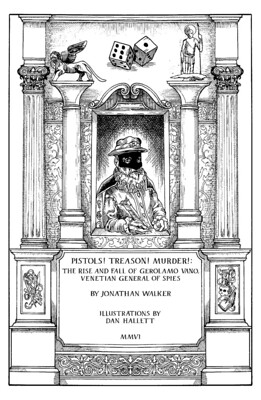
Pistols! Treason! Murder!: The Illustrations

Pistols! Treason! Murder!

Above is a slide show of selected illustrations from my first book, Pistols! Treason! Murder! These illustrations were a late addition to the manuscript. They were created by Dan Hallett, in a rush at the end of 2005, concurrently with my final edits on the text. At this point, our collaboration was still rather haphazard, and my instructions to Dan consisted primarily of scribbled notes and doodles on the backs of hundreds of pages photocopied from early modern source books.

Dan and I had first met in Cambridge in 2001, and we had worked together there to create four sample comic strip pages as an experiment. Subsequently, I had moved to Australia and Dan had moved to Spain, so when my editor at Melbourne University Press, Elisa Berg, asked if we could add more illustrations like the sample pages, I said yes, without actually being sure what that would entail.

In the event, Dan and I were able to renew our collaboration entirely by e-mail, and in a much more effective way than before, resulting not only in a new set of illustrations, all in the style of seventeenth-century woodcuts, but subsequently in an even more ambitious project: that is, our illuminated novel, Five Wounds (on which, more anon).

Wednesday, February 3, 2010

Pistols! Treason! Murder! at Rorotoko

This week, Pistols! Treason! Murder! is one of the featured books at Rorotoko, an online discussion venue. My article for Rorotoko can be found here. Below is a short extract, which explains one of the illustrations in the book.

The Wounds of Giulio Cazzari

Above: The Wounds of Giulio Cazzari, created by Dan Hallett.

This illustration accompanies the title chapter of Pistols! Treason! Murder! It depicts in allegorical form the assassination of Giulio Cazzari, one of Vano’s numerous victims.

Vano’s costume here is taken in part from that of the figure of “The Spy” in
Cesare Ripa’s Iconologia, a ubiquitous visual source book of the period. Note the cloak of eyes and ears, and the winged boots of Hermes, messenger of the gods, who was also patron of “revelation, commerce, communication and thieving” (Vano’s activities fell under all four categories).

The cup is filled with ink, but obviously alludes to the Holy Grail, while the imagery as a whole also suggests the iconography of the wounds and sacred heart of Christ. However, in the context of the book, there is a more explicit reference to a passage from an earlier chapter, “Idiolect,” in which Vano’s words, read aloud, “taste like red wine—or, to be more precise, bad red wine: acidic, furring the tongue, lips and teeth; intoxicating, yet also prone to induce sore eyes and jabbing headaches. The more of them you speak, the more they numb the mouth and brain, and induce slurring.”

Intoxication as a response to Vano’s words is a recurrent theme in the book, underlined elsewhere by another image in which I am shown drinking from the same cup into which Vano dips his pen here.

In the image above, intoxication is further associated with a kind of knowledge based on vicarious participation in historical events through exemplary re-enactment, that is with the stigmata, and with holy communion, in which a Christian devotee respectively receives the wounds of Christ, or ingests the blood of Christ. But here the sacred meaning is violently profaned. The secular grail that Vano holds aloft is therefore the elusive, unattainable goal of every historian’s quest: direct, unmediated access to the past.

Finally, the disassembled corpse of Giulio Cazzari, the victim whose remains lie within the heart at the image’s apex, also alludes to the fragmentary nature of the sources recounting his death, which cannot be stitched together into a single, coherent narrative.

To be absolutely clear, this image makes no claim to be a literal depiction of anything. Although it is composed of elements adapted from early modern sources, I have no idea what Vano or Cazzari looked like or wore. And while Cazzari certainly was assassinated as a result of Vano’s reports on his activities, his dead body was not in fact dismembered. This image is therefore a kind of diagram, one mapping arguments and elaborating subtexts rather than describing events.

None of the ideas outlined in the discussion above are expressed directly in the text of the book. Such explanation would be redundant: the argument is all there in the illustration itself, and in its implied relation to other elements of the presentation, both visual and linguistic. So another of my arguments is, in effect, that we should take images seriously as independent vehicles for complex and abstract ideas.

[There will be more on the illustrations for Pistols! Treason! Murder! in future posts ...]

Sunday, January 31, 2010

Pistols! Treason! Murder!: Judges' Comments for the 2008 Victorian Premier's Literary Awards

The following is not very topical, but I'm posting it here as a form of indexing. In 2008, the Australian edition of Pistols! Treason! Murder! was shortlisted for The Prize for a First Book of History in the Victorian Premier's Literary Awards. Below is the judges' report:

Pistols! Treason! Murder!
Jonathan Walker
(Melbourne University Publishing)

This deeply satisfying book takes readers into the world of seventeenth-century Venetian master spy, Gerolamo Vano. In the process, Jonathan Walker reveals how he creatively made history, out of a newly discovered and fragmentary archive in the form of Vano’s surveillance reports. Closely reading these documents, Walker constructs a spell-binding tale of people and place, in a book that reflects on the practice of history-making and poses large questions about the compact between historians and their readers, and what counts as a trustworthy version of a past.

Saturday, January 2, 2010

I Am a Pilgrim: Introduction

In my teens I took snapshots, as everybody does. Like all such images, they were of no interest to anyone but the subjects. I neither knew nor cared about niceties such as composition and correct exposure. For reasons that are now unclear to me, I took fewer and fewer such photographs after I left home in 1988. The very last roll of film that I began innocently, with the purity of heart that a true snapshot requires, dates from early 2000. I lost the camera before I finished it.

As a replacement, I bought one of the newfangled digital cameras – I think it had one megapixel – but it seemed too easy, too banal, so I traded it in for a second-hand Polaroid Spectra. After that, I steadily ‘regressed’ through the history of photography, beginning with a manual 35mm SLR, followed by an even older Rolleiflex, and finally a large-format bellows camera.

Nostalgia does not interest me, so I avoided photographing anything obviously related to my personal life. I also worked at night with a tripod. I wanted to slow things down, to make everything more laborious and more self-conscious. I wanted images that were the exact opposite of everything implied by the word ‘snapshot’. Some of these photographs can be found at www.letusburnthegondolas.com.

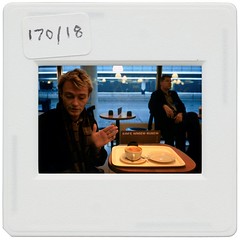
At the end of 2003, I was preparing for my first visit back to Europe after moving to Australia a year before. This global tour seemed a good opportunity to review my relationships with the people and places that mattered to me. With this theme in mind, I decided to take a series of 35mm colour slides. Again the choice of an obsolete format had nothing to do with nostalgia. Rather, it is no longer a ‘natural’ or obvious choice, so it cannot be taken for granted

What, then, are the specific properties of a 35mm slide? Like a Polaroid, it is a unique, positive image. Its creation neither requires nor permits any intervention from the photographer beyond the initial moment of exposure, and it records colour ‘objectively’. Unlike the eye, it cannot compensate for the cast of artificial light, and unlike a print from a negative, it transmits rather than reflects light. Finally, its speed is relatively slow, and its exposure range is narrow.

Traditionally, the goal with a large-format camera is to produce a hand-crafted, black-and-white print: monumental in both subject and scale. Not only does the photographer adopt a patient, meditative, awe-struck attitude, but he implicitly demands the same attitude of the viewer. Each image makes the same claim, separately.

By contrast, here we have a sequence of seemingly-casual images whose technical limitations are often glaringly obvious and which – in their original format – are experienced in succession for a few seconds as an intangible projection on a wall or screen. They no sooner arrive than they are gone. Under these circumstances, it is impossible to remember every detail.

I was looking for a balance between two opposed states of mind: dislocation and intimacy. Since this balance is a delicate one, I tried not to disturb it by thinking too much about any shot. Nor did I repeat any that failed. I did not plan, and I did not direct or solicit responses. Many of the images were shot at night or in poor interior light – all without flash. They are literally fleeting in that they are obscured by grain, deep shadows and a minimal area of focus.

It is easy to take slides in which everything is blurred. It is almost as easy to take slides in which everything is in focus. What is difficult is to make photographs that lie on the thin line between order and chaos. To put it another way, while some of these images were taken in the cold light of day, the most representative are trying to capture the precise moment when ‘not drunk enough’ is about to tip over into ‘too drunk’. In reality, that moment is anything but precise: it is as impossible to isolate as the moment when you fall asleep. But it can be identified in a photograph – if only retrospectively.

[The text above can also be found here. The slides from I Am a Pilgrim will be posted here in pairs in successive entries over the next six days.]