height

Saturday, June 5, 2021

Among Others by Jo Walton (2010)

I’ve read this book three times – in (roughly) 2012, in 2016 while I was writing The Angels of L19, and now again in 2021. My experience of it has changed significantly with each re-read. One might expect this with a book first encountered in one’s teens and re-read in middle age, but this process has taken me by surprise for a book I first read only a decade ago. Perhaps all great books do this – keep tapping us on the shoulder, challenging us to return to them.

There was a lot of buzz around this title in the SFF community when it came out – it won both the Nebula and Hugo Awards – because it is about a protagonist discovering that community as a teenager c. 1980, and in the process discovering herself. For Mor, the book's protagonist, the fellow fans she discovers in her local library’s reading group become her ‘karass’ (a word she borrows from Vonnegut’s Cat’s Cradle, meaning a group linked by an essential or true spiritual connection). And the end of the book looks forward optimistically to the expansion of this community at fan conventions, and among fellow students at university, who Mor expects to be more congenial than the games-obsessed philistines at her girls’ boarding school.

On first read, I was a little disappointed with this aspect of the book. It’s written as a diary, and some of the entries felt like mere lists of books Mor is reading (she reads very fast, over a book a day, so the novel name-checks a lot of titles). I still think it might have been better to trim some of this name-checking, even if one concedes that the novel is for fellow fans. I am about five years younger than Mor, but, while I was/am vaguely aware of many of the authors mentioned, a lot of the individual titles are unfamiliar to me. However, this doesn’t matter when the novel takes pains to explain precisely what particular books means to Mor or her fellow book-group members – on re-read, I found these more substantive discussions pitched at just the right level of detail and complexity. They’re not lit-crit evaluations. The closest the book group really gets to this is in distinguishing books that prioritise ‘style’ from those that prioritise ‘ideas’ (I’d be interested to know where this leaves Philip K Dick, who the novel largely avoids discussing). Rather, Mor uses books as ways to make sense of what’s happening to her: as models for working out and thinking through her orientation to the people and events of her life. 

This phenomenological approach is of course verboten in academic criticism, where it would be regarded as hopelessly naïve, but it’s very true to teenage experience I think. All the more so in Mor’s case, given that she lives inside an SFF story: to be precise, a fantasy story with magic and fairies.

Both these aspects of the book are defamiliarised enough to seem fresh despite their centrality as themes in fantasy – but not so much that they can’t draw some of their force from the tradition the book forms part of and is frequently in direct conversation with. That’s a difficult balance to strike, and the book does it casually. One of the ways it does so – and this is part of its example for me – is to present the fantastic elements as already familiar to its protagonist. There’s no tedious ‘origin story’ in which half the book is frittered away with the protagonist trying to come to terms with an unexpectedly transformed reality. The transformation is congenital, so to speak: magic and fairies have always been part of her reality. And even when she’s obliged to try to explain this to her new boyfriend, his immersion in SFF makes it easier for him to get his head round it all (even if he keeps insisting that the fairies might be ghosts: i.e. he’s imposing a familiar, pre-existing category – though of course that is also what Mor is doing by calling them ‘fairies’).

I wanted to do something similar in The Angels of L19, where all the characters are Christians, and therefore believe a priori in the existence of angels and demons – I am about try to manage the same trick again for a new book. That whole emotional arc of ‘This can’t be real. But what if it is real? Oh my god it’s real!’ is just of no interest to me. I want to move past it as quickly as possible – or preferably omit it entirely.

Among Others has another structural innovation: its story unfolds after the climactic confrontation in which Mor’s twin sister has been killed, and Mor herself has been badly injured, during a successful attempt to prevent their mother conducting dark magic. And we never really get a full account of this confrontation – it remains slightly out of focus, even as the ache of loss and grief for the dead sister is the book's central emotion. As Mor puts it to herself via her usual habit of comparing her situation to a story – it’s as if the entire book is focussed on the Scouring of the Shire rather than the epic quest to which it forms an appendix in Lord of the Rings

I suspect I was also disappointed with this literally anti-climactic structure on first read – the novel seems to be building throughout towards a second epic confrontation, but when this arrives, it’s over almost immediately. But this structure now seems to me both daring and interesting, and I found the book’s unusual rhythms quite satisfying on re-read. These rhythms are perhaps to do with those of adolescence: the substitution of a peer group with whom commonalities have to be discovered and constructed for a family with whom shared intimacies are taken for granted, but also ultimately limiting and even stifling. It doesn’t get more intimate than a twin sister with whom one also performs magic – and her death enacts being cast out of this charmed circle of pre-existing assumptions into a broader social universe.

I’ve seen Among Others described as YA. I don’t read enough YA to know how well it sits within that definition, but one thing it does very well is to use Mor’s teenage incomprehension of the adult world to defamiliarise that world. There’s a particularly bravura passage on class distinction as a form of magic (the latter is of course very familiar to Mor; the former, bizarre and incomprehensible).

I wonder if my initial downplaying of the book’s merits was a self-protective one: its influence on The Angels of L19 now seems very obvious to me, but writing in the direct light of that influence would have been inhibiting. For example, my novel features three scenes with characters watching films (Time Bandits, Footloose and Robert Bresson’s The Trial of Joan of Arc) and thinking about or discussing how these films fit (or don’t fit) with their Christian beliefs. It also includes characters thinking about music in the same terms. (I chose films and music rather than books because the former two are mass media and more likely to be familiar to readers, and because the Bible is the ur-book against which all other cultural productions are measured in my fictional world – it therefore leaves little room for other books). But Walton’s presentation of community, and of the interplay between the social and the esoteric, now seems just as important. And as I’ve mentioned above, her book’s acceptance of the fantastic as a given was also a model. Even her structural gambit of starting where most other stories would finish finds an echo in my novel’s continuation of its story past the expected climax – something I’ll discuss in more detail closer to publication with reference to Tolkien’s idea of the eucatastrophe: the undoing or reversal of a tragic ending. 

Since in my book this ‘fourth act’ takes the form of a re-writing of the legend of the Harrowing of Hell, I might also note that the same legend is the basis for Walton’s more recent novel Lent (although I didn’t read her take on this until I’d finished writing my book). 

There are plenty of other influences on The Angels of L19 (for example, Charles Williams), but, having just re-read Among Others, I wanted to acknowledge its importance in detail.

Thursday, May 20, 2021

A Note on Editing and Revision

I write short novels (and sometimes short non-fiction). My three published books are: 1) (non-fiction) 60,000 words (plus illustrations and extensive endnotes); 2) (novel) 60,000 words (plus extensive illustrations); and 3) (forthcoming novel) 66,000 words.

I sometimes write short non-fiction pieces (and I’ve published many articles in academic journals in the past), but I never ever write short stories. I just don’t think in ways that suit that form. But I’ll also never write a novel (or, likely, a book of any kind) over 75,000 words. I’ll never write a sequel either (the novel I’m just starting now has thematic and situational links with my last one, but no continuities of plot).

All of this makes me a very marginal writer in commercial terms, irrespective of the subject or quality of my writing. Many agents or publishers won’t look at manuscripts under 75,000 words. Nonetheless, I have no intention of padding stories out to meet artificial targets if that feels wrong to me. And interestingly, my editors generally agree – generally I get pushed to make things shorter.

For my forthcoming novel The Angels of L19 I can track word counts very precisely. The longest complete draft appears to be v59, which is 76,000 words (though I think I had already removed a couple of surplus scenes from this, so there could theoretically have been an ur version of about 80,000 words). I submitted v70 for my PhD in creative writing, and that was 73,000 words. There was some discussion around this as departmental guidelines at the University of Kent suggested it should be at least 90,000 words. My position was: that’s what I’m submitting, I’m not changing it, so feel free to fail it if you have a problem with that. In the event, I passed with no corrections. I submitted v75 to Weatherglass Books, and that was 71,000 words. The published version will be 66,000.

In other words, the editorial interventions made what was already a short book into an even shorter one. The trajectory was not to bulk it up, or fill gaps, but empty it out where it was too crowded, too stuffed with complications and explanations. Make its shape clearer and simpler, but also make it more mysterious and open – fill it with silences. I think this was right – it’s the direction my writing wants to move in. For The Angels of L19 in particular, I had the cautionary example of Donnie Darko in mind (my elevator pitch is 'Donnie Darko but all the characters are evangelical Christians'). The initial release of that film is close to perfect, even with its ellipses and lacunae. The Director's Cut can't resist explaining everything, thereby reducing mystery to banality. The differences are small, but the effect is catastrophic.

A note also on ‘versions’ or ‘drafts’: 75 plus seems a lot, and probably is. But a draft isn’t what it used to be. A new draft used to require writing or typing the entire manuscript out from scratch again, and incorporating corrections added (usually by hand) to the typescript of the previous draft. A few holdouts may still do precisely this, but for most of us, word processing means we can make a potentially infinite number of alterations to any given version of a document. I work with Word, and I move the draft number up one whenever I make what feels like a significant cut or change: whenever, in other words, I feel I might conceivably need to retain or refer back to the prior version. I write individual chapters in separate files, revising these several times before I incorporate them into the master file compiling all chapters completed thus far. This explains why I can get up to v59 before I have a proper workable complete draft. Then, for The Angels of L19, there were approx. twenty more versions after that before it went to the typesetter.

How many ‘drafts’ in old-style money is that equivalent to? I don’t really know – eight to ten total? But it’s hard to say.

I wish I didn’t feel compelled to endlessly revise and dicker about. Partly this is a function of trying to figure out an original form (first two books, which are both quite experimental formally, in very different ways), and then of trying to change my working method and master a more traditional form, but dig deeper emotionally (The Angels of L19). It’s also a function of how long it took to find a publisher for all three books: I spent five years submitting the first; the second similarly took four years (I mean after completing the first draft); the third only three – which I suppose is progress of a sort. Under these circumstances, it’s hard not to constantly second-guess what the perceived problems might be and try to make it better for the next round. But if the perceived problem is word count, then I guess I'm shit out of luck for the rest of my career.

Thursday, October 29, 2020

Christian Fantasy

My novel The Angels of L19 is a work of Christian fantasy, according to the definition of Colin Manlove: 

What we are concerned with are works [of fiction] which give substantial and unambiguous place to other worlds, angels, devils, Christ figures, miraculous or supernatural events (biblical or otherwise), objects of numinous power, and mystical relationship with some approximation of the deity; and all under the aegis of Christian belief. 

This doesn’t mean that the book has any evangelical purpose. I’m not even a practising Christian, although I grew up in that world. But it does mean that the book takes Christian belief and the Christian supernatural seriously in the conviction that an engagement with Christianity is an engagement with moral and existential questions that should be of interest to anyone. 

I wrote this novel for a doctorate in creative writing, and one of my arguments in my thesis is that Christian fantasy cannot be entirely orthodox in its theology. For it to work as fantasy, it must trespass beyond the bounds of orthodoxy: not necessarily by contradicting received belief, but certainly by supposing things of which canonical texts are silent (which it does not, of course, present as true). All the great historical examples of the genre do this: The Divine Comedy, Dr Faustus, Paradise Lost – even C. S. Lewis’s science-fiction trilogy. 

Conversely, Christian fantasy that is committed above all else to advancing particular theological speculations as true not only commits a category error, but is usually shallow and kitsch as fiction: betraying the profundity of the truths it ostensibly tries to communicate. 

Here I’d like to offer some possible comparisons to the way my book approaches the question of Christian belief. If you think the examples that follow have something to offer the Christian (or non-Christian) reader or viewer, you may find something of value in my book as well. If you think these examples are impious or blasphemous, chances are you won’t like what I’m doing either. 

Not all of these examples concern the fantastic or the Christian supernatural (and the last on the list is not even literature/fiction), but they're all useful comparisons for the way I've approached questions of faith in my novel.

Charles Williams: I shall discuss Williams in more detail in a dedicated post, since he’s an important precedent for me, and my treatment of the supernatural is directly inspired by his novels. I’ll only note here that he’s been adopted by evangelicals (and others) as a respectable author largely because of his membership of the Inklings, the Oxford group in which Tolkien and C. S. Lewis were also members. His work was admired by Lewis in particular. But his actual beliefs and practice as a Christian, and the ways in which these were translated into his fiction, were rather stranger than that association implies. In particular, his interest in magic and ritual place him in a tradition going back to people like John Dee, and other Renaissance philosophers who saw no contradiction between Christianity and magic. Anyway, more on Williams later and elsewhere. 

Flannery O’Connor: O’Connor is also a respectable Christian writer, in the sense that assessing her in these terms is relatively uncontroversial, perhaps in large part because she wrote about herself as such eloquently and persuasively. But if one were to read her fiction without knowing this, one might conclude that her intent was to parody and mock Christian belief. Consider ‘A Good Man is Hard to Find’ in which the climactic revelation of divine grace appears to come at the murdering hands of a serial killer. Or 'The River', in which a character seeking the purification of baptism drowns. I haven’t read her novels, but the plot summaries similarly seem to lend themselves to skeptical interpretations. But then, how should grace manifest itself, if not through and beyond the manifold ways we attempt to debase and complicate its operations? This is, it seems to me, the central question O’Connor is trying to address. Like her, I am interested in this question – because I too am in need of grace. Which of us is not? 

16 Horsepower: the songs of David Eugene Edwards, writing for the band 16 Horsepower, seem to be sung from the point of view of a series of Flannery O’Connor characters. The initial temptation might be to assume some Nick Cave–like theatricality, but this documentary reveals something quite different. In it, Edwards talks about how the music of Joy Division and other post-punk bands felt to him like just as important a way to approach and apprehend the divine as the gospel traditions he grew up with. There is an important truth here: the divine is a terrible thing (in the original sense of that word also familiar to Williams and O’Connor). It has nothing to do with piety, still less with sentimentality.

The Exorcist: I like both the book and the film, although the latter is probably the stronger, more original work. For a work denounced by many as evil, The Exorcist is likely to strike first-time viewers as surprisingly conservative. Indeed, it is quite plausible to read it as a piece of celebratory propaganda on behalf of the Jesuit order – apart, perhaps, from its troubling ending, in which Father Karras, left alone after the more experienced Father Merrick has succumbed to a heart attack, and frustrated by his apparent failure to drive out the demon Pazuzu, invites it to leave Regan and enter him, and then commits suicide to prevent it taking him over. Needless to say, this conclusion is not consistent with the beliefs and practices of contemporary exorcists, researched by Blatty before writing the book. For them, the power of Christ is more than sufficient to defeat any demon – without any misguided and arrogant assumption of personal responsibility. But this plot development is a pretty clear demonstration of how the demands of approved theology and the demands of fictional dramatization might clash: Karras’s actions make perfect sense in dramatic terms. Troubled by doubts throughout the story, this is his final declaration of faith, in which he imitates Christ by sacrificing himself. Whether one is willing to accept this as a legitimate idea for the novel and film to propose depends on accepting that fiction and theology have different purposes. 

The Last Temptation of Christ: I only know the Scorsese film, not the source novel. This was of course the target of a sustained campaign of protest denouncing it as blasphemous upon its original release. The most frequently cited source of complaint was the climactic sequence in which Christ, on the cross, imagines a different fate for himself, in which he might have married Mary Magdalene and lived out a ‘normal’ life as a husband and father. This is the titular ‘Last Temptation’. But underlying this is the more troubling idea that, in the film, Jesus is not initially sure that he is the Son of God. Perhaps his call to take up this mantle is actually an act of outrageous presumption? Both these elements have no canonical justification in the Gospel texts. But they seem to me to be perfectly legitimate as fiction: as attempts to think through the meaning of incarnation. How exactly does God become man? Of course He must lay aside omnipotence. Is it really so outrageous to suppose that He lays aside omniscience as well? That just as He must struggle to overcome sin, He might also struggle to overcome doubt? There is nothing blasphemous in this. Unless fiction about God is in itself somehow blasphemous. 

Piss Christ by Andres Serrano: this is a work of art of quite astonishing notoriety. Over thirty years after its creation, it is still being cited with outrage as an example of everything that is wrong with modern art, and a reason why artists should not receive public funding. It is a sculpture – although it is generally represented and reproduced via a series of photographs taken by the artist, and I'm not sure it still exists in any other form – in which a cheap plastic crucifix is depicted immersed in urine. My thoughts on this are influenced by a Twitter thread, which I can’t find now, but which I paraphrase to some extent in what follows. This work, like The Last Temptation of Christ, is about incarnation. Obviously I’ve never given birth: nor have I even been present at a birth. But I do know it is a pretty messy and excruciating event, involving a lot of bodily substances beyond the rather neutral and untroublingly transparent amniotic fluid. And Christ, moreover, was born in a stable: not places typically known for their perfect cleanliness and freedom from bodily excreta. And when Christ died on the cross, do you think that didn’t involve involuntary body functions either? God chose to become man: to subject Himself to all this: to immerse Himself in all this. To insist that it did not compromise his godhood to be vulnerable in this way. A cheap plastic crucifix presents Christ’s body as smooth and integral, as sentimental and kitsch: not as violated and broken for us. Serrano’s work is about all this: about our bad faith in sanitising what incarnation means. But if you insist on seeing Piss Christ as blasphemous, I suspect you’ll read the climax of my novel in the same way. 

In that climax, I use a similar gambit to think about the relationship between abjection and transcendence: about abjection as a doorway to transcendence and the divine. In this I also follow O’Connor, and the medieval saints who kissed the sores of lepers as a way to approach God. And I follow Dante, for whom the way to heaven led through hell: down, down, all the way to the very bottom before beginning the painful ascent back up Mount Purgatory.

Friday, October 16, 2020

Forthcoming Publication of The Angels of L19

 I'm very pleased to announce that my novel, The Angels of L19 (called Brethren in some of the posts below) will be one of the first releases from Weatherglass Books next year.

From the publisher's website:

 There’s more than one way to be born again.

Liverpool, 1984. The teenagers at Garston Chapel are the same as the rest of us: The Smiths, U2, crushes, football, mates. The grimy, low-down politics of the Thatcher era casting deep shadows in this proud and broken city, but the kids have got other things on their minds … Jesus Christ Our Lord for one.

Almost normal kids, then.

But Robert isn’t at all normal. Because Robert is visited by angels - if that’s what they are. He can’t tell a soul about his secret. All anyone can see is his strange behaviour as he desperately seeks to understand what they mean, what they want from him.

As Robert’s two worlds merge, the real and the visionary intersect with increasing intensity and what is being asked of him becomes terrifyingly clear.

The Angels of L19 is a moving and entirely original story of young lives at the confluence of faith and doubt, angels and demons, life and death. And where redemption is possible, even for those we think might be lost forever.

The Angels of L19 is extraordinary: a blend of closely-observed realism and unsettling Fantasy, wonderful, tragic and absolutely unforgettable. I don’t use the word often or lightly, but this novel is a masterpiece.

Adam Roberts, author of Jack Glass and The Thing Itself

You can preorder the book here.

Thursday, January 18, 2018

Talk at the University of Kent on Brethren

This coming Tuesday, 23 January, I'm giving a talk at the University of Kent about my novel Brethren as part of the creative writing research seminar series. It is at 1600 in Keynes lecture theatre 2. The blurb below contains (at least) one misleading statement, two doctrinal errors and one major heresy. How many can you spot?

My novel Brethren is set in an evangelical church in Liverpool in 1984. It describes a series of encounters with supernatural beings: an angel, a demon, and (in the climactic scene) an avatar of the dead Christ.

My protagonists are fundamentalists, who rely on the Bible alone for their theology and cosmology. In the Bible, angels are the messengers of God. In other words, their bodies are a medium through which messages travel: a communications technology. But angels are also God’s ambassadors. A substitute for Him. A veil over His living presence, which may be removed.

Hence, Christ is a special kind of angel. The word made flesh.

Demons are harder to define, but we know that they pretend to be angels. If Christianity is based on an ethics of substitution—Christ sacrifices Himself for us (in our place), we love our neighbours as ourselves—then demons instead usurp the place of God, which means they also usurp our place. Their aim is not to reveal or redeem the substituted thing, but to replace it.

I’ll use some episodes from Brethren to explore these ideas.

Jonathan Walker is the author of Pistols! Treason! Murder!: The Rise and Fall of a Master Spy (Johns Hopkins University Press, 2009) and Five Wounds: An Illuminated Novel (Allen & Unwin, 2010). His website is www.jonathanwalkervenice.com

Friday, October 27, 2017

Second Illustration for Brethren

BRETHREN 2

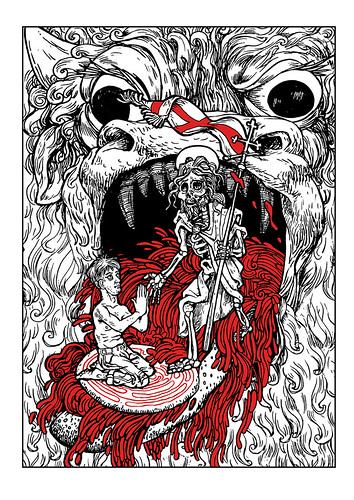
Here is a second illustration by Dan Hallett for my novel Brethren. Below is the script I initially sent to him:

Script for Dan

The second illustration is based on the iconography of the ‘Harrowing of Hell’. This legendary event purports to explain what Christ did between his death and resurrection: he went down into hell, to release the Old Testament patriarchs from limbo, and possibly preach to and rescue other ‘spirits in prison’. It was a popular story in the Middle Ages, via a compilation called The Golden Legend, and / or Latin translations of the original source, the so-called Gospel of Nicodemus (a late-classical fake).

Are you on Pinterest? There are some useful collections of medieval and early-modern visual representations there, e.g.: https://uk.pinterest.com/revjoelle/harrowing-of-hell/?lp=true

There are two basic ways of representing hell in these images: as a devouring mouth, or (seemingly much less common) as a walled city. In the former style, the mouth gapes open, and Christ seems to reach inside and lead people out by the hand. In the latter, he ‘besieges’ the gates of hell, and breaks them down, perhaps by striking them with his staff / ensign (which has the same St George’s Cross as the Agnus Dei).

In the Gospel of Nicodemus, there’s some suggestion Satan lets Christ into hell willingly, thinking Christ is defeated, not realising he’s bringing in a Trojan horse. In ch. 14 of Brethren, Jenny suggests that hell swallows Christ, but then vomits him out, because it can’t keep him down. I can’t find any visual suggestion of this last idea—perhaps because it’s too irreverent—but it echoes the story of Jonah and the whale, which was interpreted as an allegory of Christ’s death, i.e. Jonah in the belly of the whale is Christ in hell.

In keeping with the emphasis on the body in Brethren, we’re going to show hell as a mouth rather than a city. The mouth / face should have horns, and should vaguely (but not explicitly) suggest the head of a weird, demonic bull (because in the book hell is also depicted as the Minotaur / the bull-headed god Moloch). The pic will show a Robert / Everyman figure kneeling inside the mouth, hands clasped in prayer. But he’s not kneeling directly on the red tongue. Instead, he’s on a round, white communion wafer, which sits on top of the tongue. Hell is either about to try to swallow this wafer, or is in the process of vomiting it back out, but in any case, it’s sticking its tongue out, as if at the doctors.

Communion wafers are sometimes embossed with Christian symbols, one of which is the Agnus Dei (the image is also invoked in the words of the mass at the consecration of the host). Our wafer will instead by inscribed with the pattern / shape of the Chartres labyrinth from the first illustration, with Robert positioned at the centre. Not sure what this necessitates regarding the relative scale of Robert / wafer / hellmouth, but see if you can figure it out.

Re: the labyrinth pattern on the wafer. Don’t attempt to draw the path with two separate ‘sides’ enclosing a central space, as in the first illustration. Just do it as a single red line, to make it easier to draw at a smaller scale.

People in hell are always naked, so the only period indicators in medieval illustrations are in the general artistic style for human physiology (medieval faces often look a bit gormless to me)—and haircuts! But since this is (sort of) Robert, who at this point in the story has been hacking his own hair off with a pair of scissors for the past several years, his hair won’t be noticeably 80s in style. He’s also described as wearing dirty jeans in the final couple of chapters, so give him those too, but he’s bare-chested and barefoot. Robert’s ears are described as sticking out like Prince Charles in an early chapter, so give a suggestion of this, but don’t emphasise it too much, because we want to keep the dual significance whereby he stands for Everyman as well as himself (he should seem like a type rather than an individual). He should nonetheless look very much the worse for wear: bony and thin, but also a bit misshapen. He’s approx. 27 years old.

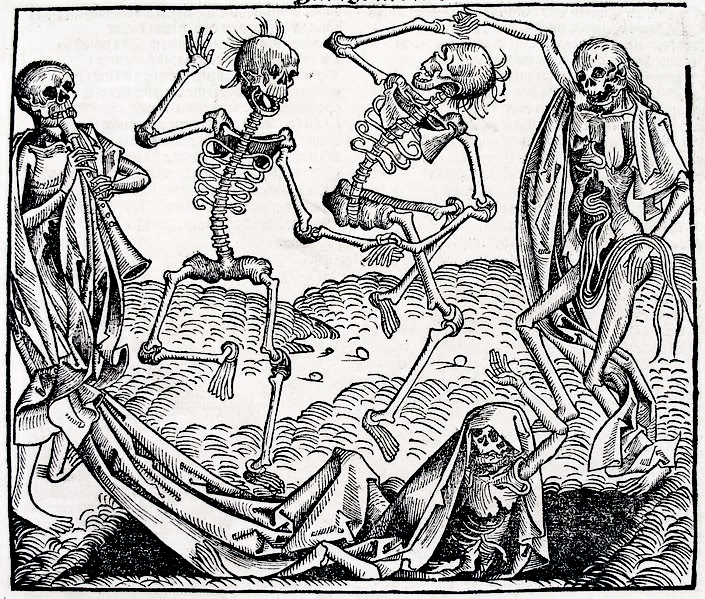
Christ stands outside the hellmouth. He’s carrying an ensign with the same design as the one in the scapegoat picture, and he has a halo. He is wearing a cloak with a shoulder brooch, as he is often represented. However, his body and face appear as that of a skeleton, like those which feature in a Dance of Death. It shouldn’t be a clean skeleton either, but one with tufts of hair, and gobbets of dried flesh and skin. Like these late-15th century examples: https://remedianetwork.files.wordpress.com/2013/01/dance-of-death.png

Skeletons in the Dance of Death sometimes have a jaunty or irreverent or mocking air. We don’t want that. This Christ skeleton should be serene and authoritative. It should also be drawn at a larger scale to Everyman / Robert, and it’s reaching down to offer its free hand for Robert to take.

Around the wafer, the hellmouth is vomiting up a flood of red wine (the blood of Christ, to accompany the body of the host). Perhaps the wafer is even floating on the flood, being carried forward out of the mouth, so the wafer’s like a raft for Robert—if you can make that work.

N. B. No demons in this hell: only the mouth.

I initially thought of having the hellmouth spewing its guts up, so that they flow around Robert and the wafer, and the coils of the guts would suggest (but obviously not directly reproduce) the shapes of the labyrinth, which in the text of Brethren is implicitly compared to both the inside of an ear and the packed cavity of the intestines. In the pic, Robert would then also be at the centre of this alternative labyrinth of guts. I don’t think this will work—it may not be obvious what the spilling guts are, or why they’re there, plus it will make the picture too busy. It’s better to keep the focus on the wafer and wine (the body of Christ inside the body of hell), but I mention it so you’re aware of some of the broader thematic issues, i.e. the association between hell and the (disintegrating, putrefying, turned inside-out) body.

Postscript

Dan did not draw Christ outside the hellmouth, reaching in to draw Robert / Everyman out. Instead, the dead Christ is inside hell, with His foot on the wafer that represents His resurrected body, which is on its way out of hell. This actually works better thematically.

Looking at the finished illustration, I thought it would not be obvious to the viewer that Robert / Everyman is kneeling on a giant communion wafer, so I added the following clarification to the end of the written text of the novel (the first illustration with the bisected goat is currently placed as a frontispiece, and this one as an endpiece):

Bill Forester once said: we remember a dead Christ, but our communion is with the risen Christ. Robert imagines a communion-wafer boat bobbing out of hell on a tide of wine. Because hell swallowed the dead Christ, but vomited up the risen Christ.

Then Christ swallowed hell.

Wednesday, June 21, 2017

Brethren

Brethren Sample Illustration 


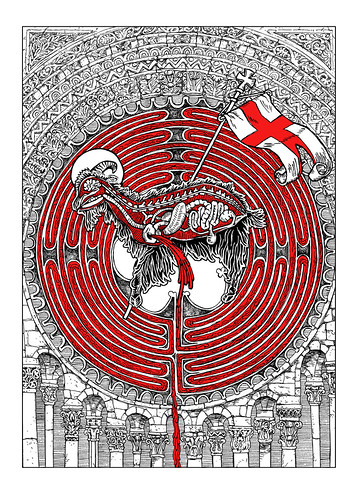
I have nearly finished a new novel, Brethren. I am now thinking about possible illustrations for this novel. As usual, I am collaborating with Dan Hallett to create a few samples for publishers, who can then decide if this is something they would like to see more of. The picture above is the first such sample. The rest of this post is a simplified account of the creation of this illustration, including: some general notes I wrote for Dan to introduce the novel; a short extract from chapter 15; and a script for this particular illustration.

General Notes for Dan

Brethren is set in evangelical Protestant church (the Brethren are a particularly austere non-conformist group). So my original idea was that its depiction of angels and demons would be rigorously Protestant, and use only Biblical sources. This is important because most of our ideas about demons, and some of those about angels, actually come from the New Testament Apocrypha (i.e. works judged unreliable by the early church) or the similar Old Testament Pseudepigrapha. But Robert’s theories about angels are taken solely from the canonical books of the Bible, which leads him to rather different conclusions to those of Christian traditions informed by these other sources.
However, Brethren is also a horror story: that is, a story in the Gothic tradition, in which the protagonist is haunted by repressed secrets. And one of the ideas behind the Gothic as it emerged in eighteenth-century novels is that England is similarly haunted by its medieval past: that is, by its Catholic past. The ruined monasteries and abbeys and castles that were the settings for Gothic fiction were ruined because of the destruction caused by Henry VIII’s reformation.
So my protagonist tries to construct an austere Protestant system of belief, but he’s haunted by Catholic ideas, which seep into his visions and experiences: e.g. transubstantiation (the idea that the bread and wine somehow become the actual body of Christ during communion), and the Harrowing of Hell (the idea, derived from the so-called Gospel of Nicodemus, that Christ preached to the imprisoned spirits in hell between his death and resurrection). I also draw on late-medieval Catholic sources like morality plays, in which the soul of Everyman was besieged by demons and angels; and medieval characters like Joan of Arc (who was visited by saints and angels).
So I want the images to have a late-medieval, Catholic feel, with a visual style from the 15th and early 16th centuries (i.e. just before the Reformation), but (if and when they include human figures) these will be dressed in 1980s clothes (I have some photos I can supply for reference, but they’re not necessary for this particular illustration). I was thinking of an engraving style, but really, if we’re talking 15th century, woodcut is more appropriate (and will probably be easier to do).
The sample illustration is based on the idea of the scapegoat from Leviticus in the Old Testament, which is discussed in chapter 15 of the novel. The relevant extract is appended below. Robert, the main protagonist, is the only one who can see or hear the ‘girl’, a.k.a. the demon Azazel. His friend Tracey’s there for moral support, as is Jenny, who’s an R.E. teacher with a background in theology. Mark’s an autodidact lay preacher. He’s the one actually performing the exorcism.

Novel Extract

‘My name is Azazel,’ the girl says.
Robert copies her. ‘Az-a-zel.’
‘What does that mean?’ Mark says. ‘Who are you?’
‘Ask Jenny,’ the girl says. ‘She knows.’
‘Jenny knows what it means.’
‘Me? I’m not …’ Everyone looks at her. ‘Fine. It’s from Leviticus. The ritual for the Day of Atonement. It might not even be a name.’
‘It’s my name,’ the girl says.
‘We don’t have theological discussions with demons,’ Mark says. ‘They’ve got nothing to teach us about God.’
Jenny pulls her bag out from under the chair, and gets her Bible out. She places it on her lap. ‘Maybe it’s something Robert needs to tell us.’
Mark says, ‘Well, there’s no harm in reading from God’s Word. But I’m not having a demon explain it to me.’
‘Take your time,’ the girl says. ‘Talk it over.’
‘On the Day of Atonement,’ Jenny says, ‘the High Priest stood before the Ark, in the presence of God. But first he had to make a special sacrifice.’
‘Nothing to do with demons,’ Mark says.
‘So he took two goats, and he cast lots between them.’
‘That’s you and Tracey,’ the girl says to Robert.
‘One goat for God; the other … for Azazel.’
‘It doesn’t say that.’ Mark gives in and goes to get his Bible from the top of the dresser on the other side of the room. He gives the bed a wide berth.
‘You won’t find it in the NIV,’ Jenny says. ‘Or the King James. Or the Living Bible. They all translate it. But they’re guessing, because no-one knows what it means.’
‘I do,’ the girl says.
Jenny says, ‘In Hebrew, it’s something like “taken away”; “removed”.’
‘Exorcised,’ the girl says.
‘In the Greek version of the Old Testament, it’s “a thing that keeps illness away”. Like a charm.’
‘Except not like a charm at all,’ Mark says. ‘Because that would be the occult.’
‘In the Latin Bible, it’s caper emissarius. Messenger goat. Scout, spy.’
‘Angel,’ Robert says.
Jenny flicks through her Bible to Leviticus. ‘In English, it’s usually scapegoat, but Tyndale invented that word in 1530 for his translation, and everyone else copied him. Except the RSV.’ She reads, ‘The goat on which the lot fell for Azazel shall be presented alive before the Lord to make atonement over it, that it may be sent away into the wilderness to Azazel.
‘So the High Priest sacrifices one goat; sprinkles its blood in the Holy of Holies. Then he puts his hands on the head of the other, and confesses the sins of the people.’ She reads again. ‘The goat shall bear all their iniquities upon him to a solitary land. To Azazel. Which could just be a place in the desert. Or a demon who lives there.’
‘Both,’ the girl says.
‘Jesus,’ Mark says. ‘He’s the scapegoat.’
‘But they don’t kill the scapegoat,’ Tracey says. She hooks her feet around the front legs of her chair and looks down again.
‘Right,’ Jenny says. ‘Literally, “the goat who escapes”. Because it doesn’t matter what happens to it, after they send it away.’
‘One for God,’ the girl says, ‘one for me. But the one for God dies; and the one for me lives.’
Robert doesn’t believe her. ‘Maybe Azazel kills the scapegoat.’
‘Jesus is the scapegoat,’ Mark says. ‘And He wasn’t sacrificed to a demon.’
Jenny closes her Bible, but keeps her finger inside it to mark her place. ‘Why Azazel, Robert?’ she says, as if he chose the name. ‘Did you hear it in a sermon?’
Robert makes his hands into fists. ‘No.’
‘In the desert, outside the camp.’ Jenny taps her Bible against her knee. ‘The Greek word for hell is Gehenna. Name of a place outside Jerusalem where people sacrificed their children.’
‘Maybe Abraham went there to kill Isaac,’ the girl says, drawing patterns on the quilt with her finger.
‘In Jesus’ day, it was abandoned, cursed. A rubbish dump.’
‘So Azazel is hell?’ Robert says, thinking of Jesus in the wilderness, tempted by Satan. Maybe that was Gehenna too.
‘I don’t know.’
‘If Azazel eats the goat, does that mean it’s eating sin?’
‘What else would a demon eat?’ Mark says.
Jenny says, ‘In medieval paintings, the entrance to hell is a mouth. So when Jesus dies, it tries to eat Him. But He’s too pure; it can’t digest Him. So it spits Him out.’
‘Does Azazel spit the scapegoat out?’ Robert asks.
The girl burps.
‘We don’t need to know this,’ Mark says. ‘It’s not relevant.’
Jenny says, ‘Christ bears the sins of the world, but He’s still pure. He takes the penalty, but not the guilt.’
The girl burps again, and says, ‘His flavour doesn’t change. He still tastes the same.’
‘For the scapegoat, it’s more like the other way round. It takes the guilt, but not the penalty.’
‘You take the penalty; Tracey takes the guilt,’ the girl says to Robert. ‘Or the other way round. It’s up to you.’
‘I don’t want it to be up to me.’
‘Robert,’ Mark says, ‘stop talking to it.’
‘But it is up to you,’ the girl says. ‘So who do you want to be? The goat for God; or the goat for Azazel?’

Script for Dan

A really boring illustration of these ideas would be a picture of two goats: maybe one black, and one white. So I thought, what if it’s not two goats? What if it’s half a goat? This ties in to another famous Biblical story about King Solomon, who decided to cut a baby in half to find out which of two women was the mother: she was the one willing to give the baby away rather than see it harmed. In the context of the novel, depicting the goat cut in half could suggest that choice is painful, disruptive, and reveals secrets (the inside of the goat). It always involves violence and the renunciation of possibilities (by choosing one thing, by definition you exclude another).
I started off by thinking of Damien Hirst’s Mother and Child, but if you look at the cross-sectioned cow in that, its interior just seems a mess. It’s difficult to make out the shapes of internal organs, etc. So we want a goat cut in half, but rendered somewhat non-realistically, more like the ‘self-dissecting man’ from the anatomy treatises of Vesalius, who displays all his internal organs, etc. In fact, the high priest often had to separate individual organs as part of the different Old Testament sacrificial rites.
So: a cross-sectioned black goat, with a (probably simplified and stylised) set of visible internal organs.
The idea that the scapegoat is Christ also made me think of the image of the Agnus Dei, the Lamb who takes away the sin of the world, which is shown with a halo, carrying a flag with a Saint George’s Cross. So our goat will similarly have a halo and flag. It’s both the Lamb of God and the scapegoat. But a goat (particularly a black goat) is normally a Satanic symbol, so it’s also both Christ and the devil.
The Hirst cows look very odd with only two legs, and similarly I suspect it will be difficult to render a convincing two-legged goat. This is something you’ll have to figure out. I guess the Hirst one is neither sitting nor standing, but suspended, and that’s probably the impression we want too.
Brethren also has several allusions to the Minotaur and the labyrinth, which represent the devil and hell in medieval allegory, with Theseus as Christ, penetrating the labyrinth to kill the devil. So one final layer is to have a red maze in the background behind the goat. This maze begins / comes out / is analogous with the spaces between the goat’s various internal organs, i.e. the organs sit on a red background inside the goat, where they block out most of that background, reducing the visible part of the background to a series of lines, whose shapes resemble those of a maze / labyrinth. A drop / line of blood trickles out of the goat and down onto the background of the page, where it begins another, similar path through a larger maze / labyrinth. (N. B. For reference, there’s a labyrinth filled by an advancing rivulet of blood in the first Hellboy film.)
The blood coming out of the goat is therefore a trickling red thread like the thread Ariadne gives to Theseus in the minotaur's labyrinth. So there's a sense in which we should be able to see the blood flow as reversible: we should be able to follow its thread from the outside inwards, as well as from the centre out.
Mazes / labyrinths are common elements in the floor decorations of medieval cathedrals, where they represent the idea of pilgrimage. Here’s the one from Chartres: http://www.luc.edu/medieval/labyrinths/chartres.shtml In this context, it's Jerusalem at the centre of the labyrinth, not the devil. This alternative, positive meaning ties in with the goat / lamb doubling / superimposition.

Wednesday, September 3, 2014

Jon's Notebook

My photography project 'Developing Writers' shows the subjects with their notebooks. Here's a page from my notes relating to the printing of the portraits and accompanying images:

Sunday, July 6, 2014

Street Level Photoworks

This is where I am currently developing my negatives:


I was really pleased to discover such a great public darkroom in Glasgow.

Thursday, July 3, 2014

New Photography Project

I am currently working on a new photography project: my first using a large-format camera since 2005. It depicts Glasgow University creative writing students with their notebooks, in the setting of the university’s Hunterian Gallery. I wanted to use a large-format camera in order to retain resolution in the text on the notebook pages, which occupy a relatively small area in the composition, but are its literal point of focus. The theme is of ‘Developing Writers’, and it seemed appropriate to use analogue technology to depict the similarly analogue character of handwritten notebooks by writers in the process of revising themselves as well as their final portfolio submissions.

 I found this project very challenging on a technical level, for reasons that would not be appropriate to explain at length in a general discussion of the images, but which I’d like to review here, if only for my own satisfaction.

 First of all, I was out of practice with the large-format camera. That’s like being out of practice at running: it takes time to recondition your body to work within the machine's protocol. Secondly, I have never developed my own negatives before. I’ve always made my own prints in a wet darkroom, but for previous projects I shot away from home, and I had the negatives developed by someone else. This wasn't really an option here in Glasgow, and it took me quite a while to get the hang of this part of the process. Numerous fogged or stained films bear witness to my difficulties. Thirdly, the light levels in the Hunterian are low, and the light is also very flat. Using the slow lenses of a large-format camera, the best aperture / shutter speed combination I could get was f8 and 1/15 of a second, even on a 400ASA film pushed one stop to 800. That’s very slow for a portrait, and even at f8, the depth-of-field on a 210mm lens was often only a few centimetres.

I focussed on the handwriting on the notebook pages, but I often couldn’t see clearly enough on the ground-glass screen to get critical focus, or alternatively the sitter moved a few centimetres before exposure, or the paper shifted very slightly during the exposure (sometimes it was 1/8 of a second; occasionally 1/30). Any of these variations was enough to fuzz out the letter shapes on the notebook page, and the human eye has no tolerance for fuzzy typography. Whereas a face can be slightly out of focus and still seem natural, any loss of sharpness in written letters looks ‘wrong’.

In addition to this, the resolving power of my 210mm portrait lens is not as great as I would like. My 90mm wide-angle has much superior optics, but isn’t great for portraiture. I also used a Fuji 6 x 9 as a backup camera, which does have a great lens, and a convenient rangefinder focussing mechanism. I sometimes found that the resolution on the notebook pages was better on the smaller negative of the 6 x 9 than on a large-format negative from the 210mm.

These are all technical problems, but, even assuming that I managed to resolve them all, which I did on maybe one in three negatives, that simply established the preconditions for a successful portrait. Success depends on capturing an interesting psychological truth or moment from the sitter, and I am a very poor director of people.

 I was helped in this by the presence of Katy Hastie during most of the sessions. During the set-up, she talked to sitters about her side of the project, which involves a questionnaire and discussion of creative-writing pedagogy.

 I would set up the camera to determine the edges of the frame, and then place the sitter within that space. Katy compared the second phase to being at the opticians (‘Left a half-step, right a quarter step, notebook up ten centimetres, face turned slightly to your left; now hold that while I put the darkslide in the camera back’). Of course, from my point-of-view all those directions had to be given while viewing the image upside-down and back-to-front.

The really crucial elements in a portrait are facial expression and body language, and the sitter had to discover those while trapped in the vice of the technical limitations.

I expect to get 8-10 successful photographs from about 75 sheets of large-format film and 30 or so rolls of 6 x 9 film. That failure rate is more or less consistent with previous projects. Since I’m not a professional photographer, the only edge I have is in my willingness to edit ruthlessly.

Samples to follow on Flickr.