I reread Catch-22 when I was in the middle of writing Five Wounds, to get me in the right frame of mind.
Wednesday, June 2, 2010
Tuesday, June 1, 2010
Five Wounds: Interview in 'The View From Here'
Q. Was the collaboration on Five Wounds a more straightforward process for having previously worked together on Pistols! Treason! Murder!?
A. The illustrations for Pistols! Treason! Murder! were completed in a rush on a very tight deadline. That had its advantages: it means they have a certain crude aggressive energy to them. It’s punk history, after all. For Five Wounds, I had the chance to think things through, and to theorise it more. And there are several different kinds of illustration, several different layers, which involved different methods of working. So Pistols! was more like the first rush of discovery, live on stage, and Five Wounds is more like tinkering around in the studio for months overdubbing. Pistols! is an amphetamine book; Five Wounds is a morphine book.
Thanks to Paul Burman, who conducted the interview and wrote the review.
Also out is an interview I did for The Cairns Review.
Sunday, May 30, 2010
Article on The Revenger's Tragedy
The cover of Harold Bloom's best-selling Shakespeare: The Invention of the Human features a painting by Michelangelo, whose images of titanic individuality have long been recognised as a visual correlative of Shakespeare's great tragic heroes. By contrast, the Italian artist whose vision most resembles Middleton's is not Michelangelo, but his darker, more realistic successor, Caravaggio - who, like Middleton, was celebrated in his own time, but then ignored or disparaged by centuries of critics uncertain of his canon and shocked by his style.
Caravaggio's sympathetic, sensual Mary Magdalen could be the protagonist of Middleton and Dekker's comedy The Honest Whore. Middleton's tragedies can be as lurid, brutal and demystifying as Caravaggio's Judith and Holofernes. Caravaggio's torn, furrowed-browed Doubting Thomas, caught red-handed in that electric moment when scepticism thrusts its finger into faith, could be doubting Thomas Middleton's Timon ("I must ever doubt, though ne'er so sure") or Vindice ("O, I'm in doubt, whether I'm myself or no"). Caravaggio's Saint Jerome, alone, writing at a desk dominated by a skull, could be Middleton's morbid, isolated, intellectual revenger.
Tuesday, May 25, 2010
Inspirations: William Blake
The following are from the illustrations for Dante's The Divine Comedy. The first is Dante running from the three beasts (the Leopard, Lion, and She-Wolf respectively from the bottom up); the second is the Wood of the Suicides:
The following are from Blake's illustrations for The Book of Job. The first is Behemoth and Leviathan; the second is the original watercolour of the same on which the engraving is based; the third is Job's Despair; the fourth is The Lord Answering Job out of the Whirlwind:
We did consider framing the Plates in Five Wounds in a similar manner to the way that these engravings for the Book of Job have been surrounded with text, but in the end we felt that it might have been too much in the context of the novel. It is, however, an idea I intend to return to.
Five Wounds: Review in 'The View from Here'
Jonathan Walker’s delight in playing with words, names, images, extends to Dan Hallett's wonderful illustrations. There’s the sense that each picture adds extra detail to the story – beyond the words. Take, for instance, the description of the public servant’s half-eaten salami sandwich when Cur is receiving instructions for an assassination. The reader is invited to question exactly what the salami is constituted of and then presented with an illustration of the salami-bound pig in question feeding on the entrails of an earlier assassin's victim. Certainly a case of what goes around comes around.
Saturday, May 22, 2010
Five Wounds: Interview on FBi Radio
Monday, May 17, 2010
Five Wounds: Review from The Age, 15 May 2010
The template suggests an old-fashioned children's classic: handsome proportions, elegant print, fancy chapter headings, centre plates on shiny paper. But a virus has gotten in there: the illustrations are nightmarish and hermetic, calling on the Tarot, Escher, psychotic heraldry, and the text here and there is scribbled through, the nice fonts mocked by scrawled block capitals. And the story likewise takes the blackness that underpins traditional fairytales and brings it front and centre.
The last book writer Jonathan Walker and illustrator Dan Hallett collaborated on was Pistols! Treason! Murder!, a "punk history" about the life of a 17th-century Venetian spy and rogue. This book breathes something of that atmosphere, while taking the properties into a fantastical realm.
In an imaginary city-state five outsiders, each with their wounds and powers, become involved in an obscure conspiracy, five cards being played by unseen hands. There's eclecticism in the writing as well as the illustrations: the X-Men and the Bible are both here, Heart of Darkness, Calvino, and although the book is too text-based to be a graphic novel, it's in the vein of comics that happily steal from all over. This makes for instability, and the writing has its flat spots, but the book takes you places, and the illustrations are wonderful.
Sunday, May 16, 2010
Inspirations: The Divine Comedy by Dante Alighieri
“[I]f one is to read Dante, and understand him, one must become a Christian if only for a few hours”.
Donna Tartt, The Secret History, p. 184
“He thou dost gaze on, pierced by the triple stake, Counselled the Pharisees ’twas expedient One man should suffer for the people’s sake.
Naked, transverse, barring the road’s extent, He lies; and all who pass, with all their load Must tread him down; such is his punishment.
In this same ditch lie stretched in this same mode His father-in-law, and all the Sanhedrin Whose counsel sowed for the Jews the seed of blood.”
Then I saw Virgil stand and marvel at him Thus racked for ever on the shameful cross In the everlasting exile.
Dante, Hell, canto 23, lines 115-26, trans. Dorothy L. SayersI read Dante as an undergraduate, in the Penguin translation by Dorothy L. Sayers, who is better known as the writer of a series of detective novels featuring Lord Peter Wimsey, but was also an accomplished scholar. She not only translated Dante for the Penguin Classics series, but also the early-medieval French chanson, The Song of Roland.
The Sayers translation of Dante is aggressively odd, because, rather than writing in idiomatic English, she used conscious archaisms. It’s not quite cod-Shakespearian, but ‘dost’ and ‘twas’ were verging on the ridiculous even in 1949, when ‘Hell’ (as the first volume was bluntly translated) was first published. The odd locutions were further exaggerated by tortuous syntax, which was the result of Sayers’ ambitious (some would say foolhardy) decision to retain the terza rima structure and stress patterns of the original verse as far as was possible in English.
Terza rima is an Italian verse form of great elegance, which uses the rhyme scheme ABA BCB CDC DED etc. I always think of this interlocking structure in visual terms as being like a dovetail joint in woodwork. Rhymes are ubiquitous in Italian poetry, which is one of the reasons why English poets have always felt obliged to use them, i.e. because of the influence of Italian models like the sonnet, and in spite of native Anglo-Saxon precedents that were instead based on alliteration and assonance, but – for technical reasons it would be tedious to explain here – it is actually much more difficult to find rhymes in English than it is in Italian. In an epic work like Dante's, this is a serious problem, and one that becomes progressively more difficult for a translator to resolve satisfactorily.
Thus Sayers’ sets herself an impossible task, in the pursuit of which she frequently ties herself up in lexical knots, but, even so, I find her translation more compelling than most of the modern editions, which abandon the attempt and therefore inevitably render the verse as elevated prose. Sayers’ translation instead treats the text as something alien, something fundamentally other, that can only be expressed in English via a series of violent and artificial transformations (a pity she never had a go at Ovid). Some of it is truly risible, like her decision to render the sections of Provencal dialect as Scots brogue, but even there, you have to admire her chutzpah.
The crowning glory of the Sayers translation is not, however, the verse itself, but the extensive commentary, which takes up as much space as the poetry. Sayers has a great advantage over other editions here, in that she was a committed Christian who took all the theology very seriously, as, if not necessarily the literal truth, then certainly an essential truth, which is inseparable from the allegorical cast of mind that informs The Divine Comedy. In the Introduction to Hell, Sayers quotes Dante’s own explanation of allegorical interpretation.
The meaning of this work [The Divine Comedy] is not simple ... for we obtain one meaning from the letter of it, and another from that which the letter signifies; and the first is called literal, but the other allegorical or mystical. And to make this matter of treatment clearer, it may be studied in the verse: “When Israel came out of Egypt and the House of Jacob from among a strange people, Judah was his sanctuary and Israel his dominion”. For if we regard the letter alone, what is set before us is the exodus of the Children of Israel from Egypt in the days of Moses; if the allegory, our redemption wrought by Christ; if the moral sense, we are shown the conversion of the soul from the grief and wretchedness of sin to the state of grace; if the anagogical, we are shown the departure of the holy soul from the thraldom of this corruption to the liberty of eternal glory. And although these mystical meanings are called by various names, they may all be called in general allegorical, since they differ from the literal and historical.
The subject of the whole work, then, taken merely in the literal sense is “the state of the soul after death straightforwardly affirmed”, for the development of the whole work hinges on and about that. But if, indeed, the work is taken allegorically, its subject is: “Man, as by good or ill deserts, in the exercise of his free choice, he becomes liable to rewarding or punishing Justice”
(quoted in Hell, ‘Introduction’, pp. 14-15).
(The last term in this schema, ‘analogical’, means using the literal event to figure a spiritual reality, or sometimes more specifically a truth relating to the fate of the soul after death.)
In the 1949 Penguin edition, the translation and the commentary are two sides of the same effort of interpretation, in which re-enactment is both the enabling technique and the goal, an endeavour to which Sayers is willing to commit herself, because, for the most part, she shares (or believes herself to share) Dante’s presuppositions and beliefs.
Sayers applies Dante’s four-part interpretative schema to the passage quoted above, which describes the fate meted out in hell to Caiaphas, the Jewish high priest who decided to seek Christ’s execution, who is crucified eternally (the same punishment he wished upon Christ). He is also laid on the ground to be trod underfoot by the Hypocrites, whose step is heavy indeed, since they are all wearing lead cloaks. (Such efficiency is common in the moral economy of Hell, where, for example, the Profligates run through the Wood of the Suicides, pursued eternally by black dogs, and in fleeing, they tear the branches from the bleeding trees in which the souls of the Suicides are imprisoned.) With regard to Caiaphas, Sayers explains:
This image lends itself peculiarly well to Dante’s fourfold system of interpretation ... (1) Literal: the punishment of Caiaphas after death; (2) Allegorical: the condition of the Jews in this world, being identified with the Image they rejected and the suffering they inflicted – “crucified for ever in the eternal exile”; (3) Moral: the condition in this life of the man who sacrifices his inner truth to expediency (e.g. his true vocation to money-making, or his true love to a political alliance), and to whom the rejected good becomes at once a heaven from which he is exiled and a rack on which he suffers; (4) Anagogical: the state, here and hereafter, of the soul which rejects God, and which can know God only as wrath and terror, while at the same time it suffers the agony of eternal separation from God, who is its only true good (Hell, p. 217).
I have only read through The Divine Comedy once, and only in Sayers’ translation (although I can at least claim to have read all of it, i.e. I did struggle through the Purgatory and Paradise after Hell). Several passages and images from it have remained with me, but, with all due respect to Dante, it is through the force of Sayers’ imagination that his original lives for me. It is the relationship between the translation and the commentary that is truly compelling. It is her effort to understand, and to communicate that understanding, which moves me as much as anything in the poem itself.
Sayers’ relationship with Dante is therefore quite different to the relationship between Eric Newton and Tintoretto, as I described it in a recent post. She proves that it is possible to collaborate with someone who has been dead for hundreds of years (something I also tried to do in Pistols! Treason! Murder!). As a postscript, I might also mention two artistic ‘collaborations’ with Dante: the first is a series of watercolours by William Blake, to which I may dedicate a subsequent post; the second is another edition of the Inferno, now long since out of print, which was both translated and illustrated by the artist Tom Phillips, whose work in A Humument is also an important precedent for some of the features of Five Wounds.
Friday, May 14, 2010
New Database for 'Underground and Independent Comics, Comix, and Graphic Novels'
The database is probably available via your local college / university too. If it's not, you're at the wrong institution.
Monday, May 10, 2010
Friday, May 7, 2010
Interview on Canvas on FBi Radio, 94.5FM, Sydney, etc.
I also did an interview recently for the Faster Than Light show, which is broadcast first in Perth, and then syndicated to community radio stations all across Australia. Not sure when that will be available, but I'll let you know.
My apologies for all the short, bitty entries. I shall shortly be posting some substantive discussion of Five Wounds, via guest posts at Spike, the Meanjin blog (on collaboration).
Saturday, May 1, 2010
Five Wounds is Released!
Come and say hello at Kinokuniya in Sydney, above Town Hall station, from about 1-4 p.m. There are copies of the book for sale, and I have free postcards and stickers to give away.
There are also definitely copies available at my local book store, Better Read Than Dead, in Newtown, Sydney (thanks Karen!). Check in the window. Postcards there too.
Also available in all good book stores throughout Australia, probably from Monday-ish.
Also available direct from the publisher, Allen & Unwin, here.
Tuesday, April 27, 2010
Appearance during Free Comic Book Day at Kinokuniya, Sydney
I'll be there to sign copies from about 1-4 p.m. I'll be the one not dressed as a Star Wars character.
There will also be a Dalek in attendance (no relation).
There will be a discount on the cover price of Five Wounds for anyone buying on Saturday.
Zoe's Thesis
El Globo, Issue 1
Thursday, April 22, 2010
Pistols! Treason! Murder!: Review from History Australia
REVIEW OF JONATHAN WALKER’S PISTOLS!
TREASON! MURDER! THE RISE AND FALL OF A
MASTER SPY, MONOGRAPH AND WEBSITE
According to Iain McCalman, Jonathan Walker’s Pistols! Treason! Murder! is the ‘first true work of “punk history”’. If what is meant by ‘punk history’ is carefully stage-managed historiographical defiance, McCalman’s description is apt. At first sight, the focal point of Pistols! Treason! Murder! is Gerolamo Vano, a self-fashioned Venetian ‘general of spies’ whose life unravelled into a noose in 1622. A closer look at the text and its accompanying website, though, reveals that the work is as much about Walker’s ways of composition and historiography as it is about the shaping and pathology of self in seventeenth-century Venice.
Walker’s acknowledged sources of historiographical inspiration include Stephen Greenblatt’s Renaissance Self-Fashioning, microhistories ranging from Natalie Zemon Davis’s The Return of Martin Guerre to McCalman’s The Seven Ordeals of Count Cagliostro and Walter Benjamin’s unfinished posthumous work, The Arcades Project. Chief among these sources perhaps is The Arcades Project, for Pistols! Treason! Murder! has the form of an apparently random series of quotations, observations, notes and interviews. Between chapters 16 to 20, for instance, we pass from excerpts from the chief source of information about Vano – file 636 in the Venetian archives – to an analysis of the meaning of ‘honour’ in seventeenth-century Venice, to the purported transcript of a conversation between Walker and two other historians in an Irish pub, to Walker’s testing of Vano’s geography from a report dated 10 April 1622 and eight possible readings of it, to a comparison of the material fabric of Venice with the chief archival sources.
The ‘arcades’ flavour of the book is reinforced by the related website, which offers browsers information on the historiographical and popular cultural sources for Walker’s writing – including songs by Johnny Cash and The Afghan Whigs – vivid colour pictures of the textures of Venice and most usefully, ‘deleted scenes’. The ‘deleted scenes’ include the papers Walker published on the project prior to the book, and excluded chapters on the spy as flaneur and intellectual history. These segments of the website, in combination with the marvellous central image by Hallett of the project as a tree of knowledge – and even temptation, given the representation of the link to file 636 as an apple – and the flip book sequence in chapter 28 of the book show that Walker’s project is as much a homage to and revisitation of visual as well as print culture.
Readers more accustomed to the conventional arrangement of biographical material according to a chronological or thematic scheme may find the book and accompanying website jarring. That, Walker would probably insist, is a good thing, for Vano’s activities cannot be rendered coherent. Archival gaps will not allow it, but moreover, as Walker claims:
Each story in Vano’s reports contains or opens up the possibility of another
that undoes or reverses it. Each collapses as a direct consequence of attempts
to shore it up. No possible scenario accounts for everything. As I read the reports,
I ‘crashed’ repeatedly: irretrievable error; the system has shut down. I
could not leave Vano alone, but he offered no answers to any questions that a
respectable historian might want to ask. Instead he demanded a more daring
and radical response, in which obsession itself becomes a strategy (p. 7).
This quote is important, for it highlights the differences between Pistols! Treason! Murder! and The Arcades Project. Many commentators have noted that Benjamin’s Project can be arranged and rearranged, and read and re-read in any number of different ways. Almost entirely absent from Benjamin’s Project are the motifs that individuals use to connect and therefore render their experiences meaningful. In Pistols! Treason! Murder!, there are at least three meaning-makers: Vano, Walker and the illustrator Dan Hallett. The Vano of Pistols! Treason! Murder! is engrossing and somewhat akin to the character of Tony Wilson in 24-Hour Party People, ascribing, erasing and re-ascribing meaning to peoples’ actions in order to place himself in a past that delivers respect and financial reward. In his world, a cough might signal betrayal and the promise of recognition and reward. Or it might simply be a cough. We can never be sure. The patterns of Vano’s rhetoric are intriguing, but ultimately only hinted at in the text. As Richard Evans noted in Kneipengespräche im Kaiserreich, the rhetorical form of intelligence reports is an important part of their meaning, not an obstacle to a ‘real’ individual. A closer look at Vano’s language, and the comparative analysis of other informants might suggest a more conventional individual than we can currently see.
Arguably, Walker is sketched in more depth than Vano: literally in graphic-novel illustrations provided by Dan Hallett and figuratively in his self reflections on his ‘obsession’ with Vano. Early on, for instance, he eschews Simon Schama’s Dead Certainties in favour of the multiple typefaces pioneered in works like Richard Price’s Alabi’s World. In so doing, he affirms a world in which boundaries between fact and fiction and primary and secondary sources matter. Moreover, the historiographical metaphors that he employs – the historian as pathologist and psychic – are now quite conventional and in the latter case, rest upon the problematic reading of historical understanding as an epistemological rather than conceptual activity. Has he, like the protagonist of the Radiohead song, 2+2=5 (the title for chapter 23 of Pistols! Treason! Murder!) succumbed to historiographical ‘doublethink’?
Even if the answer to that question is yes, Pistols! Treason! Murder! is still a stimulating and provocative read. It is punk history, but probably more in the tuneful style of The Jam than the manufactured chaos of The Sex Pistols.
Monday, April 19, 2010
Inspirations: Something Wicked This Way Comes by Ray Bradbury (1963)
'No such place as Heck. But hell's right here under 'A' for Alighieri'.
'Allegory's beyond me', said Jim.
'How stupid of me,' Dad laughed. 'I mean Dante. Look at this. Pictures by Mister Dore, showing all the aspects. Hell never looked better. Here's souls sunk to their gills in slime. There's someone upside down, wrong side out'.
'Boy howdy!' Jim eyed the pages two different ways and thumbed on. 'Got any dinosaur pictures?'
UPDATE: Hello to visitors from raybradburyboard.com. I first read Something Wicked This Way Comes when I was 13 or so - about the same age as its protagonists Will and Jim - and my paperback is a very yellow copy of the tie-in edition from the (rather disappointing) film version of 1983, although I had already read a library copy several months before buying it, appropriately enough, given that Will's father is a librarian, and the town library is the setting for a crucial scene. It is one of only two books from my teen years that I read through a second time immediately upon finishing it (the other one will be the subject of a subsequent post). I remember being particularly delighted by the one sentence chapter 'Nothing much happened all the rest of that night' (which I quote from memory, so I may have got it wrong). Fahrenheit 451 also made a big impression on me, and, although I have never been a big short story fan, I read several volumes of Ray's short fiction on the basis of my enjoyment of the novels.
In addition, the quotation above may be the first place I ever came across the name 'Dante'.
Sunday, April 18, 2010
Appearance at this year's Sydney Writers' Festival
The event takes place on Sunday May 23, 1-2 p.m., at the Museum of Contemporary Art, where there is a Zine fair taking place at the same time, so there should be a well-informed audience. Entrance is free.
Saturday, April 17, 2010
Five Wounds: The Black Dog and The Bagatto
Wednesday, March 31, 2010
Five Wounds: Dan Hallett
Friday, March 26, 2010
Pistols! Treason! Murder!: Textual Realism and Reenactment
Above: The Arrest of Antonio Foscarini (click to enlarge)
This illustration is the centre piece of a strip that summarises Gerolamo Vano's fall from grace, which was connected to the arrest of a noble named Antonio Foscarini. The charges against Foscarini were not proclaimed publicly, which provoked a great deal of ill-informed gossip, a state of affairs that is dramatised in the illustration. The background is the Great Council Hall in the ducal palace, where the entire noble class met for debates and elections.An argument that is never explored directly in the text of the book is dramatised visually in this illustration. At the same time that the Venetian state was beginning to mount systematic surveillance operations targeted at individuals, Galileo was busy up the road in Padua, observing the surface of the moon and the satellites of Jupiter, and drawing some startling conclusions. By 1622, the year of Vano’s execution, the first microscopes were circulating among curious cardinals in Rome. Moreover, the first question raised by Galileo’s critics was the same one asked by Vano’s readers: How can you be sure of what you have seen? So there is an obvious connection to be made between the spy and the scientist. As Foucault would argue, power—in the form of surveillance—and knowledge —in the form of scientific observation—were intimately connected. This argument is alluded to directly by the ‘signature’ on the telescope at upper left.
The motif of the flies serves more than one function. Flies are not just examples of a preferred subject for early microscopic observations. They also refer to a linguistic metaphor introduced in a much earlier chapter. In the relevant passage I am addressing the reader directly in the portentous voice of ‘The Historian’.
The living body does not exist for us, cannot speak to us, even if the corpse still hosts a different kind of life that has nothing to do with the consciousness that once inhabited it. Rather, this life is parasitical—a swarming mass of signs, continually multiplying, crawling across the page. Their buzzing is loudest around the body’s wounds, where the text is most ‘corrupt’, as the philologists put it. The ligaments and cartilage that once articulated it have rotted away.
This passage foreshadows a later throwaway comment about Foscarini’s trial, in which ‘No one ever originated rumours; no one confirmed or denied them. They were generated spontaneously, like flies in rotten meat’. The illustration echoes all these previous allusions to flies. Finally, I suspect that these overdetermined insects are also direct descendents of Mosca, the buzzing parasite from Ben Jonson’s play, Volpone.
No doubt I’m already testing your credulity, but there is yet another argument implied by the contents of the other two telescope bubbles, in which the ‘thing’ being observed is actually a written text. This apparent paradox raises a point about the relationship between eyewitness testimony and hearsay and their respective evidential value in law—an issue that was crucial in the trial, condemnation and execution of Antonio Foscarini. The same point is also hinted at by the frieze of alternating eyes and ears, which have temporarily migrated to the panel border from Vano’s cloak, where they normally reside (because Vano is not in control of the flow of information in this panel). Theoretically, evidence based on sight (the most noble of the senses) was of greater value that evidence based on hearing, which was frequently dismissed as mere gossip. However, in practice that distinction was virtually impossible to maintain, as the outcome of Foscarini’s case demonstrates eloquently. Again, this issue is not discussed explicitly in the text.
Monday, February 15, 2010
Pistols! Treason! Murder!: Review from Library Journal
Strip away the whiz bangs here—comic-strip sequences, chapters in which the author and friends meet in cafés to talk over their obsession with the past, time-sequence photographs of a flintlock firing—and this is first-rate history, just of a different kind. The flashy stuff works here, with an effect similar to that of Michael Lesy's groundbreaking 1973 Wisconsin Death Trip, where Lesy's pictorial editing forced the reader to look at events a second time, catching nuances that might otherwise have been missed. Walker (research fellow, Univ. of Sydney) describes an incident of spying in 1622 Venice. A master spy, Gerolamo Vano, presents evidence that leads to a Venetian nobleman's hanging on charges of espionage. Five months later, Vano himself is executed for falsifying evidence, and the nobleman is absolved posthumously. But this book isn't just about Vano, about whose machinations the evidence is spotty. It's as much or more a reflection on how one approaches the historical record: how to exhume a coherent narrative from uneven, desultory, and usually self-serving reports. VERDICT This book will infuriate as many scholars as it excites, but it is original, well written, and good. It should intrigue anyone who likes reading history.—David Keymer, Modesto, CA
Thursday, February 4, 2010
Pistols! Treason! Murder!: The Illustrations

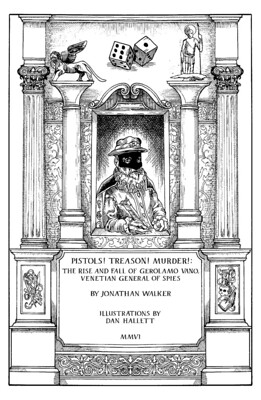
Above is a slide show of selected illustrations from my first book, Pistols! Treason! Murder! These illustrations were a late addition to the manuscript. They were created by Dan Hallett, in a rush at the end of 2005, concurrently with my final edits on the text. At this point, our collaboration was still rather haphazard, and my instructions to Dan consisted primarily of scribbled notes and doodles on the backs of hundreds of pages photocopied from early modern source books.
Dan and I had first met in Cambridge in 2001, and we had worked together there to create four sample comic strip pages as an experiment. Subsequently, I had moved to Australia and Dan had moved to Spain, so when my editor at Melbourne University Press, Elisa Berg, asked if we could add more illustrations like the sample pages, I said yes, without actually being sure what that would entail.
In the event, Dan and I were able to renew our collaboration entirely by e-mail, and in a much more effective way than before, resulting not only in a new set of illustrations, all in the style of seventeenth-century woodcuts, but subsequently in an even more ambitious project: that is, our illuminated novel, Five Wounds (on which, more anon).
Wednesday, February 3, 2010
Pistols! Treason! Murder! at Rorotoko
Above: The Wounds of Giulio Cazzari, created by Dan Hallett.
This illustration accompanies the title chapter of Pistols! Treason! Murder! It depicts in allegorical form the assassination of Giulio Cazzari, one of Vano’s numerous victims.Vano’s costume here is taken in part from that of the figure of “The Spy” in Cesare Ripa’s Iconologia, a ubiquitous visual source book of the period. Note the cloak of eyes and ears, and the winged boots of Hermes, messenger of the gods, who was also patron of “revelation, commerce, communication and thieving” (Vano’s activities fell under all four categories).
The cup is filled with ink, but obviously alludes to the Holy Grail, while the imagery as a whole also suggests the iconography of the wounds and sacred heart of Christ. However, in the context of the book, there is a more explicit reference to a passage from an earlier chapter, “Idiolect,” in which Vano’s words, read aloud, “taste like red wine—or, to be more precise, bad red wine: acidic, furring the tongue, lips and teeth; intoxicating, yet also prone to induce sore eyes and jabbing headaches. The more of them you speak, the more they numb the mouth and brain, and induce slurring.”
Intoxication as a response to Vano’s words is a recurrent theme in the book, underlined elsewhere by another image in which I am shown drinking from the same cup into which Vano dips his pen here.
In the image above, intoxication is further associated with a kind of knowledge based on vicarious participation in historical events through exemplary re-enactment, that is with the stigmata, and with holy communion, in which a Christian devotee respectively receives the wounds of Christ, or ingests the blood of Christ. But here the sacred meaning is violently profaned. The secular grail that Vano holds aloft is therefore the elusive, unattainable goal of every historian’s quest: direct, unmediated access to the past.
Finally, the disassembled corpse of Giulio Cazzari, the victim whose remains lie within the heart at the image’s apex, also alludes to the fragmentary nature of the sources recounting his death, which cannot be stitched together into a single, coherent narrative.
To be absolutely clear, this image makes no claim to be a literal depiction of anything. Although it is composed of elements adapted from early modern sources, I have no idea what Vano or Cazzari looked like or wore. And while Cazzari certainly was assassinated as a result of Vano’s reports on his activities, his dead body was not in fact dismembered. This image is therefore a kind of diagram, one mapping arguments and elaborating subtexts rather than describing events.
None of the ideas outlined in the discussion above are expressed directly in the text of the book. Such explanation would be redundant: the argument is all there in the illustration itself, and in its implied relation to other elements of the presentation, both visual and linguistic. So another of my arguments is, in effect, that we should take images seriously as independent vehicles for complex and abstract ideas.
[There will be more on the illustrations for Pistols! Treason! Murder! in future posts ...]